
Overview
Custom agents let you create AI-powered assistants with:- Custom instructions — Define how the agent responds.
- Enterprise knowledge — Connect internal data sources.
- Tool integrations — Access external systems and APIs.
- Configurable behavior — Control tone, scope, and capabilities.
Agent Types
| Agent Type | Description | Best For |
|---|---|---|
| Prompt Agent | LLM-powered agent with custom instructions and variable-based prompts | Content generation, text transformation, data analysis |
| API Agent | No-code integration with external REST APIs and systems of record | Real-time data retrieval, triggering external actions |
| Search Agent | RAG-based retrieval from Search AI or Amazon Q indexes | Enterprise search, documentation Q&A |
| Agentic Flow Agent | Sequential multi-agent workflows with decision logic | Complex processes, multi-step automation |
| Autonomous Agent | Self-directed agent connected to Agent Platform via API | Research, complex automation, long-running tasks |
| Bot Agent | Conversational bot built on AI for Service Platform | Guided workflows, form filling, structured interactions |
| Workflow Agent | Integration with Agent Platform workflow automation | Business process automation, sync/async workflows |
| MCP Agent | Tools hosted on Model Context Protocol servers | External tool connections, multi-system workflows |
Prompt Agents
Prompt Agents collect specific user inputs as variables to customize prompts, enabling content generation, language translation, text summarization, and similar tasks. Administrators create and configure these agents; users interact with them to produce consistent, standardized outputs.When to Use Prompt Agents
Content Generation and Standardization- Creating standardized documents (job descriptions, project proposals, marketing copy) that follow organizational templates.
- Generating consistent reports, summaries, or communications that maintain brand voice and formatting.
- Producing multiple content variations for A/B testing or different audiences.
- Translating content into multiple languages while maintaining context and tone.
- Summarizing lengthy documents, reports, or meeting transcripts with consistent structure.
- Converting technical documentation into user-friendly formats or different complexity levels.
- Processing uploaded files (.pdf, .docx, .csv, .xls) to extract insights, generate summaries, or create reports.
- Analyzing data patterns and generating standardized analytical reports.
- Creating executive summaries from complex datasets or research documents.
How Prompt Agents Work
Prompt agents operate using two components:- User-Collected Inputs: User inputs are incorporated into the prompt as variables to generate the required response. For example, a job description (JD) is created using user inputs about experience, responsibilities, and required skills.
- Administrator-Uploaded Knowledge: Administrators upload a file used as a template. For example, a JD is generated based on user-provided inputs and a pre-uploaded template that ensures consistency and formatting.
Import an Existing Prompt Agent
-
Click Import Agent in the upper-right corner.

-
Select the
.ZIPfile of the existing agent.
- Click Import. The imported agent appears on the Agents page.
Create a Prompt Agent
Navigate to Admin Console > AI Agents > Prompt Agents, then click +Create Agent.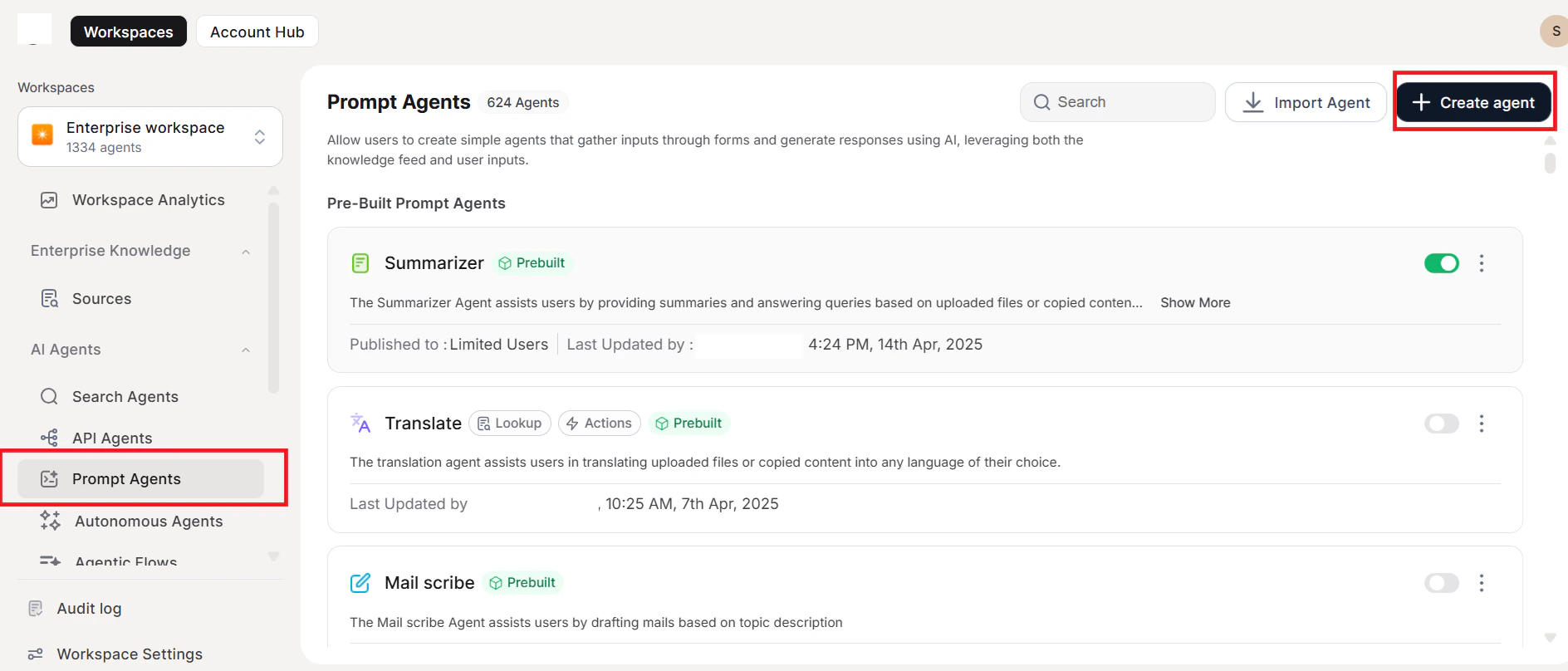
Step 1: Details and Purpose
Provide a unique name and describe the agent’s purpose. The system auto-generates fields, queries, and prompts based on the purpose provided. To change the icon, click the logo above the agent’s name and choose a predefined logo or upload a custom one. Click Continue.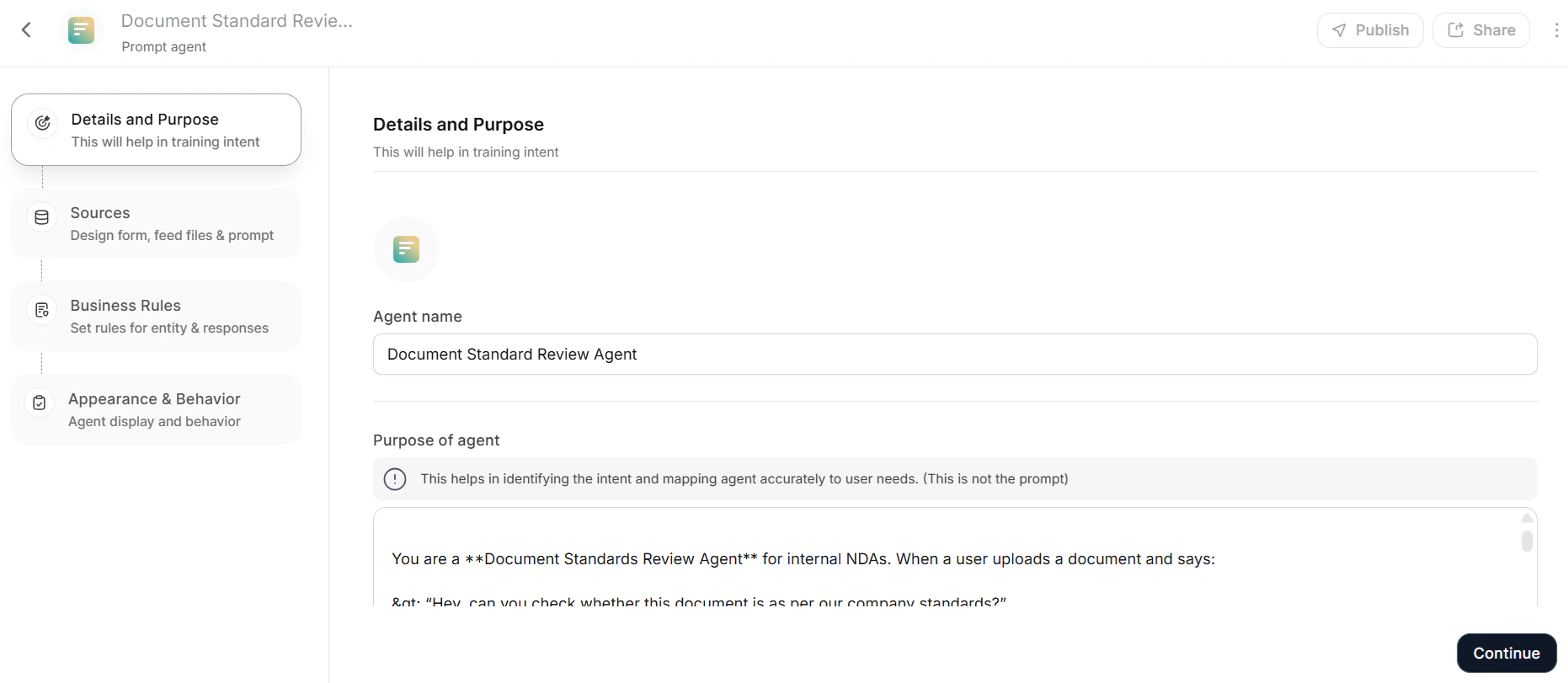
Step 2: Source Configuration
Configure the following sections in the Sources step.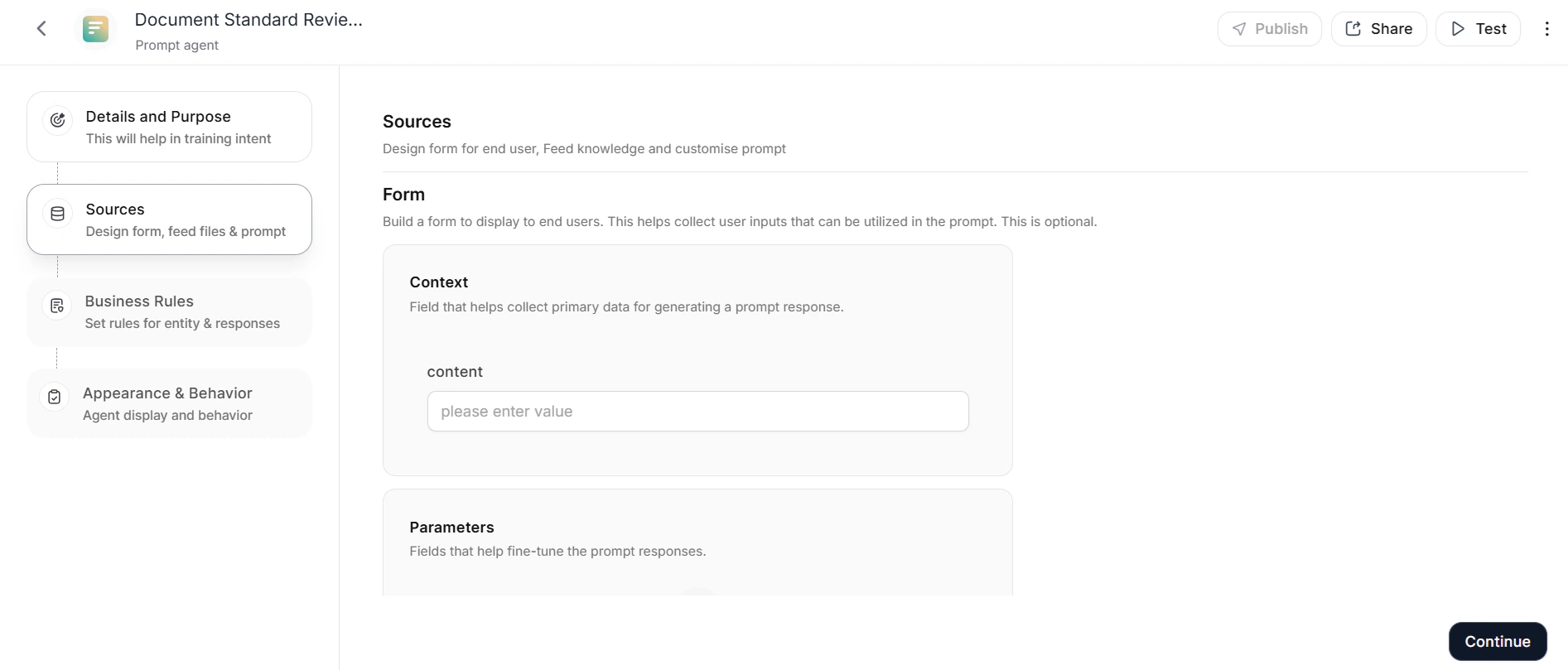
User Input
- Click +Add context to add a context field.
- Enter a context name and optional placeholder text. Placeholder text appears in the form field before the user provides input.
-
Select the Field type: single-line, multiline, or file upload.
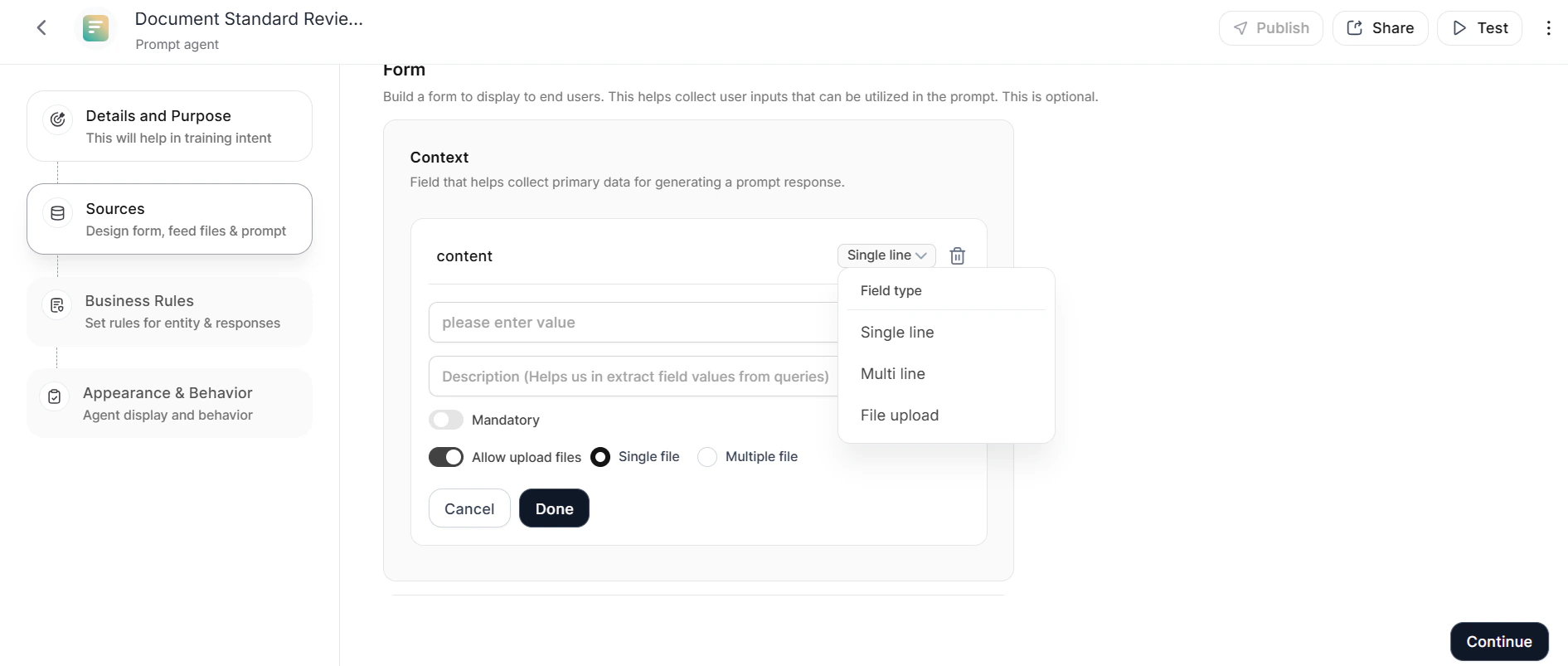
- Toggle Mandatory if the field is required, then click Done.
- In the Parameters section, fields are pre-populated based on the agent’s purpose. Click +Add field to add more.
- For each parameter field, enter a name, placeholder text, and a Description that explains the field’s purpose in detail — this helps the LLM identify and pre-populate the field from natural language queries. For example, if you need a field for organizational departments, name it and describe that it accepts internal department names so the LLM can match it from queries.
- Select the Field type: single-line, multiline, single-select, multi-select, number, or file upload.
-
Toggle Allow Upload Files or Allow URL Content to enable file uploads or URL-based retrieval. This option is available only for single-line and multiline text fields.
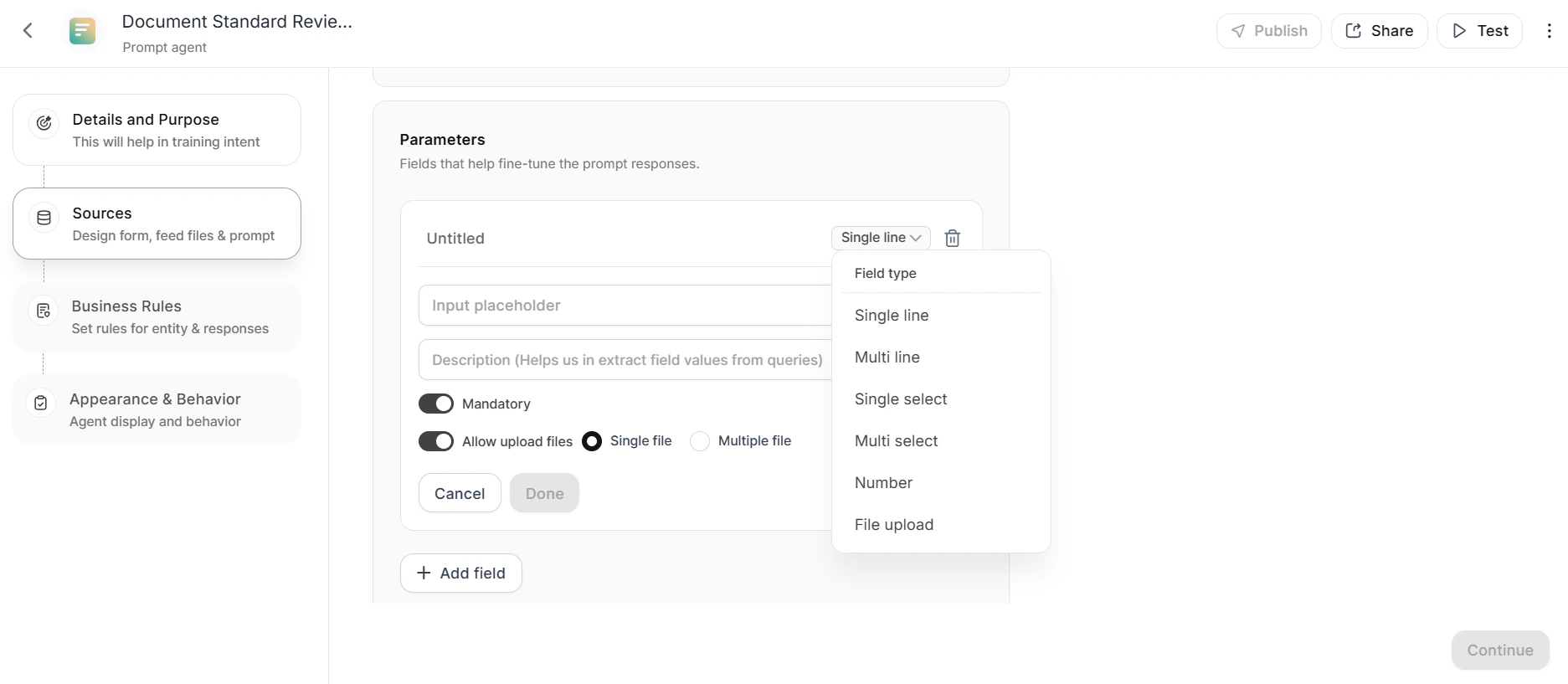
- Toggle Mandatory if required, then click Done.
Knowledge
-
Click + Upload to upload a knowledge file (template, reference document, etc.) that the agent uses to generate responses. You can reference uploaded files directly in prompts. For example: “Create a JD in the same format as the Sample JD template file.”
 If the file size exceeds the model’s context limit, an error is displayed listing affected models. When the limit is exceeded, all uploaded knowledge files are referenced for answering but not for generation.
 -
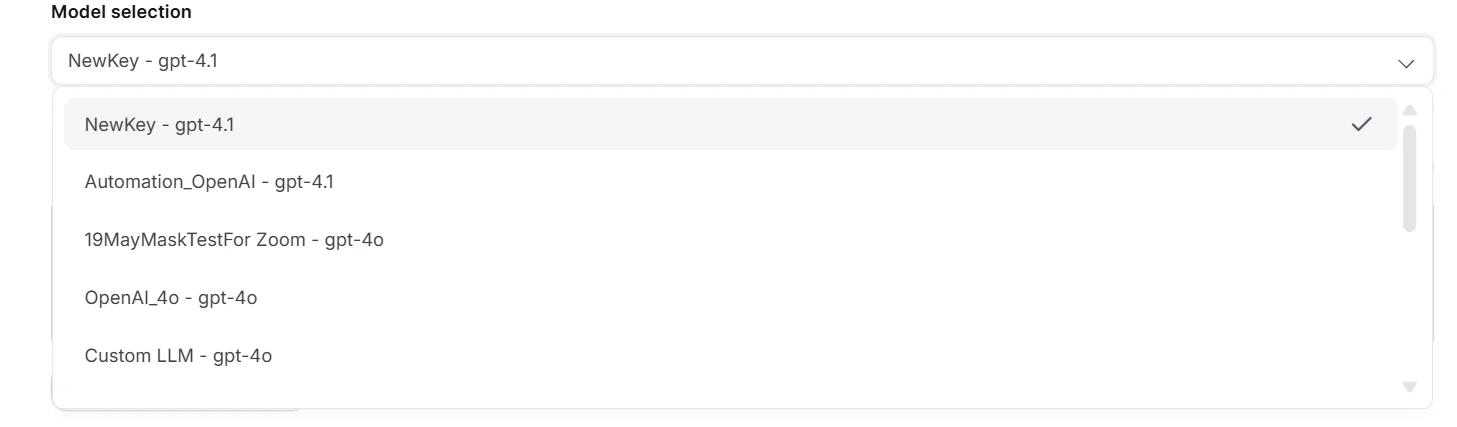
Select the model from the Model selection drop-down. To learn more, see LLM Configuration.
-
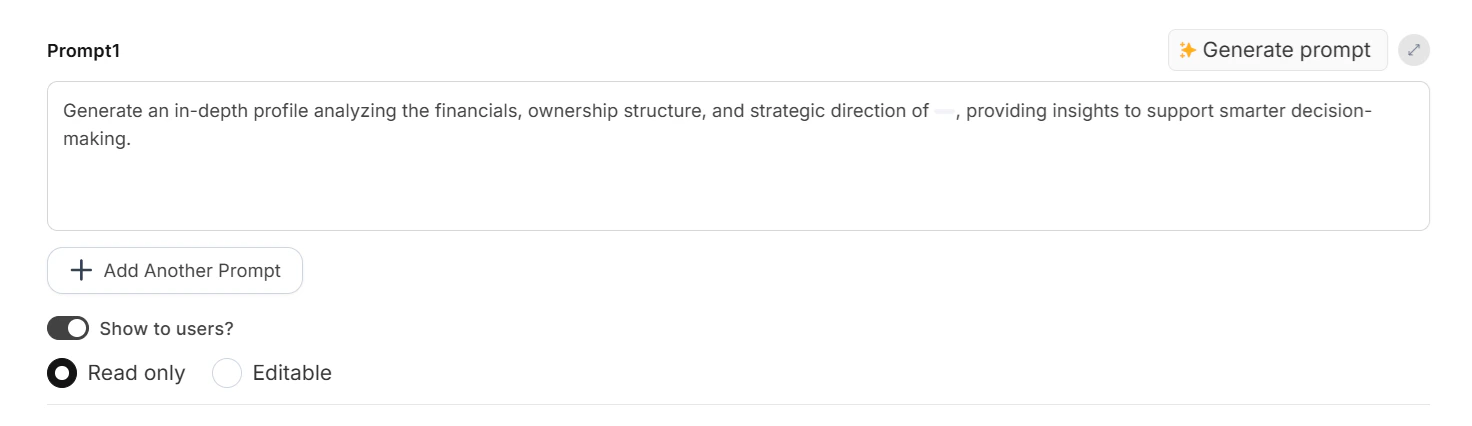
Toggle Show to users to display the prompt to end users. When enabled, select Read-only or Editable.
Prompts
A default prompt is auto-generated based on the purpose defined earlier and can be customized using variables. For example, a “Job Finder” purpose generates a prompt with fields like Company Name, Job Title, and Responsibilities. Enable Show to users to display the prompt to end users. Select Read-only or Editable.Multi Prompt
For agents that offer multiple prompt options, click + Add another prompt to add prompts. You can rename prompts and drag-and-drop to reorder them. Click Generate prompt to auto-generate a prompt based on the form’s purpose and field values. When multiple prompts exist, a Prompt Selector field appears for end users:- Click the edit option or anywhere in the prompt area to expand available options.
- Edit the prompt selector’s field name and optional placeholder text. The Mandatory toggle is enabled by default and cannot be modified.
- The Prompt Options list shows all created prompts — drag and drop to reorder.
- Click Done.
Multi Response
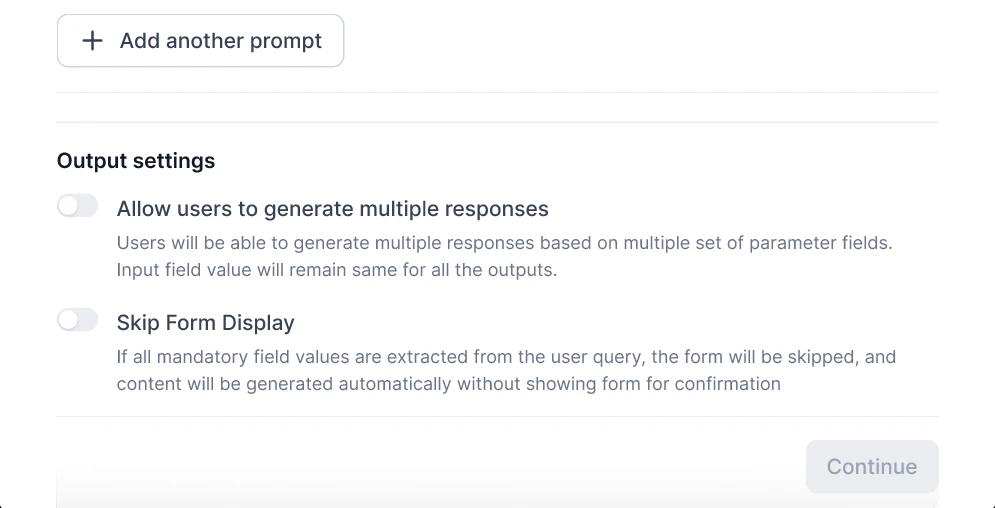
To allow users to generate multiple responses:- Enable Allow users to generate multiple responses in the output settings.
-
Enable Skip Form Display to automatically bypass forms when all required entities are present in the initial query. This feature prevents conflicts with Multi-Response and shows messages for incompatible settings.
- Click Continue.
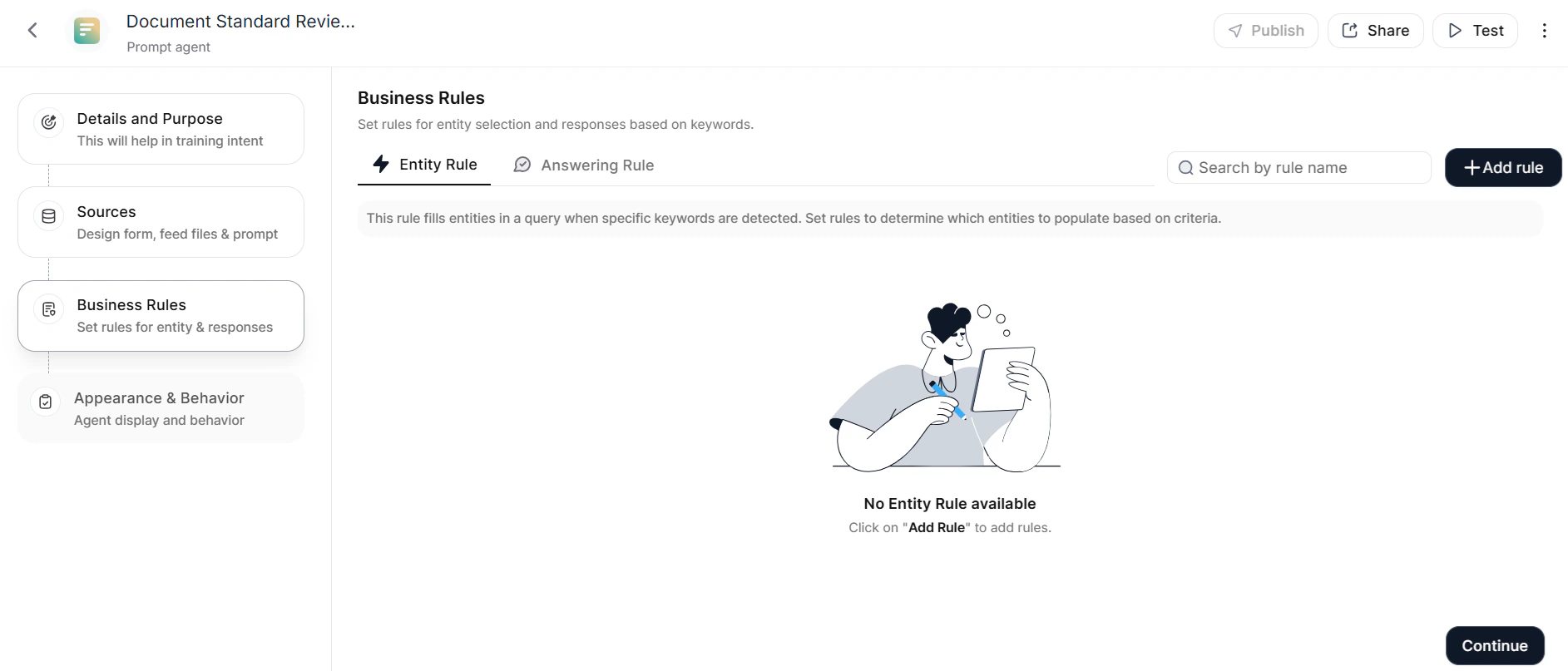
Step 3: Business Rules
Set rules to fill entities automatically when specific keywords are detected, controlling entity selection and response behavior. Configure either:- Entity Rule: Automatically adds entities to queries based on detected keywords, even if the user doesn’t mention them explicitly.
- Answering Rule: Controls and customizes responses when specific conditions or keywords are met.
Step 4: Appearance and Behavior
A list of sample queries is displayed. Click + Add Query to add more. Enable Clear End-User Chat History to automatically delete the agent’s chat history after a specified period. Click Publish to proceed.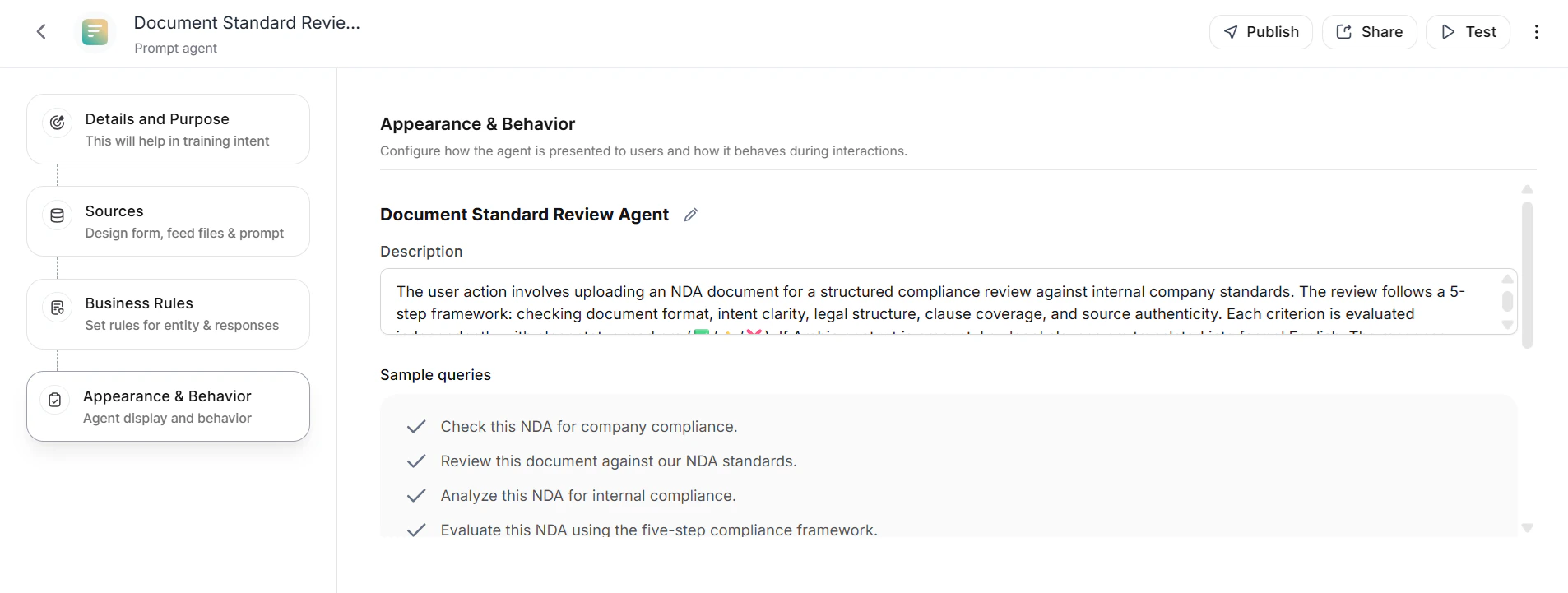
Step 5: Publish
See Publishing Your Agent.User Interaction
Users submit queries to initiate interaction. The agent processes inputs and provides contextually relevant responses. Users can upload files (.pdf, .docx, .csv, .xls) or provide URLs — the system processes content and generates summaries, reports, or insights. When multi-response is enabled, users select Additional Response to generate additional outputs. Each response can use the initial input or the output from a previous response as its input source, enabling chained workflows for multiple perspectives or output formats.API Agents
API Agents integrate with legacy systems and external REST APIs using a no-code builder, enabling users to query business data through natural language.Key Features
- Easy Setup: Step-by-step wizard in the Admin Console
- Flexible Configuration: Supports various API types, authentication methods, and data processing options
- Customizable Fields: Select and configure up to 10 fields for querying and display
- Intelligent Querying: Handles simple lookups, compound queries, and computational requests
- Data Processing: ID and meta-resolution for presenting meaningful information to end users
- Preview and Testing: Validate configurations before publishing
- Sharing Options: Share with specific users, groups, or the entire organization
Prerequisites
API Requirements:- Standard REST APIs with JSON response format from Systems of Records (SOR)
- Maximum 500 records per API call
- Stable API endpoints with consistent data schema
- Customer Relationship Management (CRM) platforms
- Enterprise Resource Planning (ERP) systems
- Human Resources Information Systems (HRIS)
- Database management systems with REST API access
- Business applications with well-defined data models
- Administrator access to the system you want to integrate
- API documentation for the Schema API and Action API
- cURL commands for the ID resolver and meta resolver
Create an API Agent
Navigate to Admin Console > AI Search > API Agents, then click + Create Agent.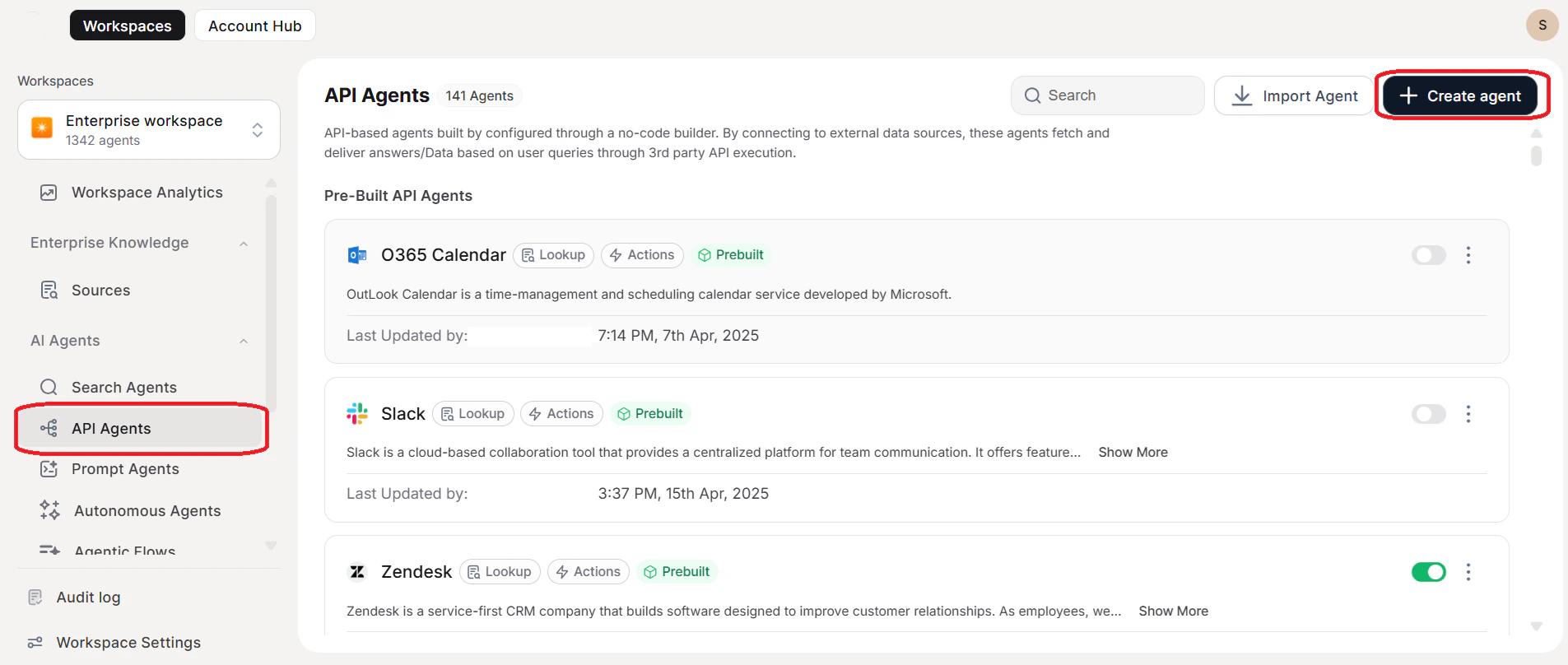
Step 1: Purpose of Agent
Describe the system to integrate and the desired actions in 50 words or fewer. Example: “Integrate Jira system to manage tickets. Actions include getting ticket details, creating new tickets, or updating existing tickets.” This purpose helps the agent understand your system’s capabilities and accurately interpret user intents. Click Continue.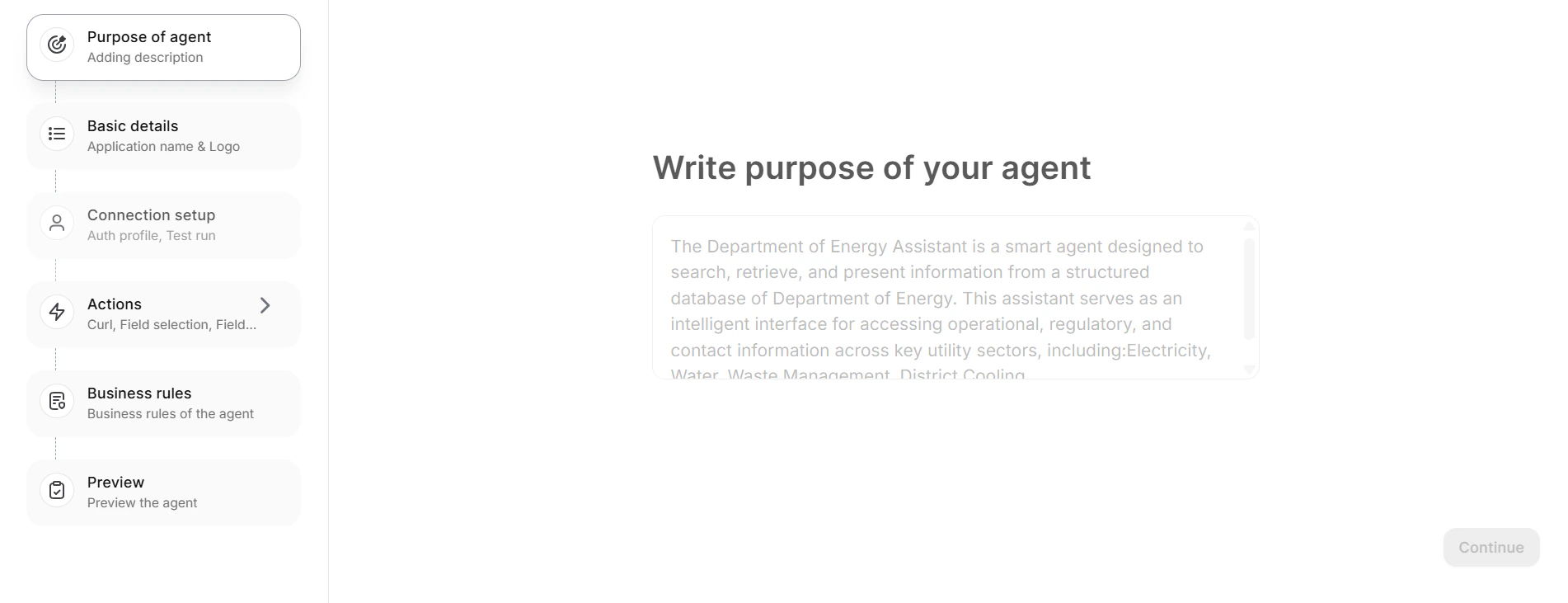
Step 2: Basic Details
Provide the Agent Name and select a Logo (from presets or upload a custom image). The name and logo identify the agent in the user interface. Click Continue.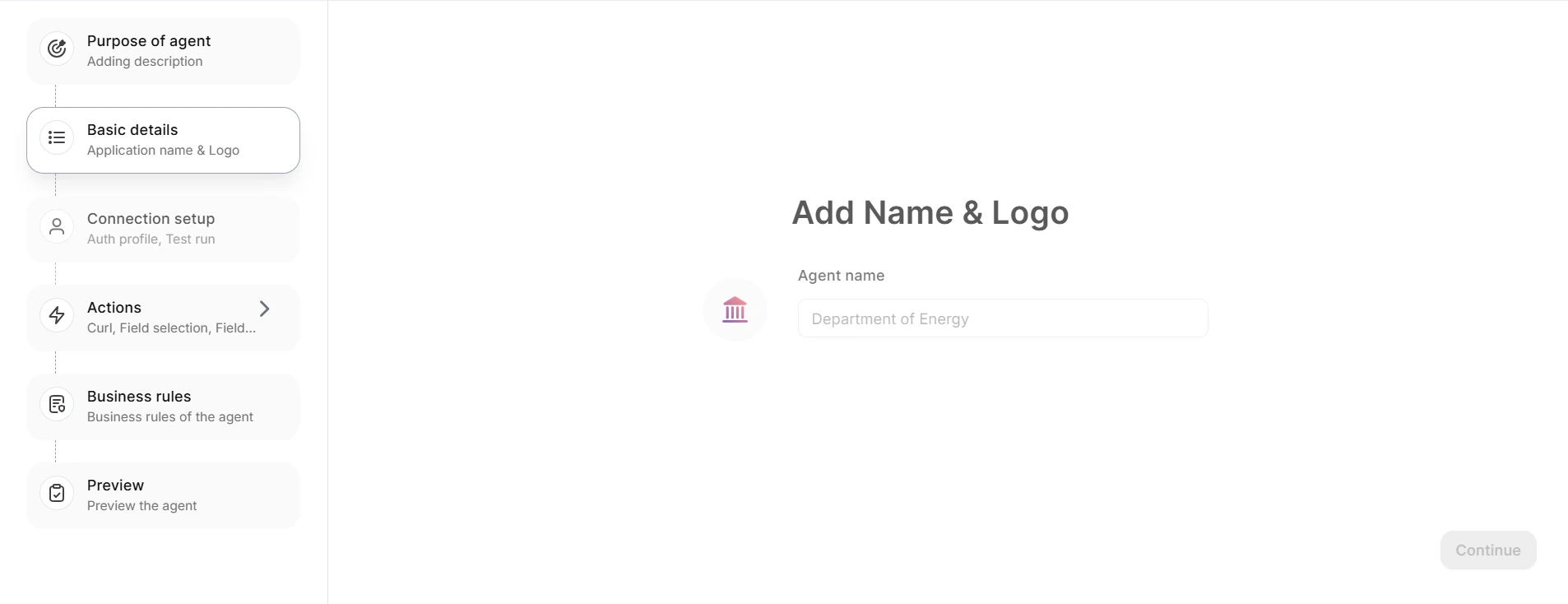
Step 3: Connection Setup
Connection Setup uses admin-provided profiles. The system accesses data using admin tokens for all retrieval operations. End users cannot create new connection profiles.Step 4: Actions
Step 4.1: Purpose
Describe the specific action this agent performs, including what information it retrieves and from which fields. Example: “Get Jira issues based on assignee, priority, status, and due date.” The agent currently supports GET and POST actions. Click Continue.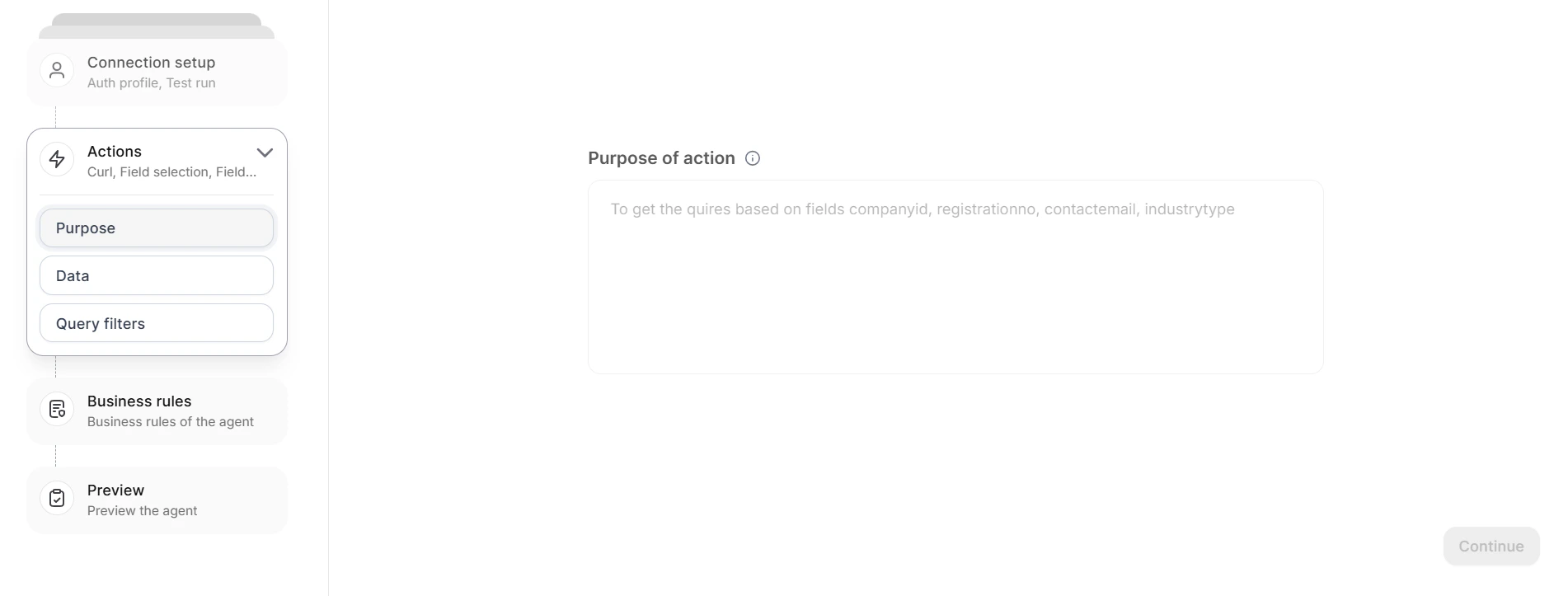
Step 4.2: Data
Have Definition API Choose how to define the data structure:- API defining the fields: Select if you have an API that explicitly defines data fields. Helps with field names and pre-fills values for single-select and multi-select fields.
- Continue with Data API: Select if you don’t have a data-defining API. This skips the Schema API and Label Selection steps, going directly to the Data API tab.
- On the Schema API tab, define the API manually or click CURL Import.
- In the import pop-up, paste the URL and click Import.
- Click Run. On success, click Continue. If an error occurs, an appropriate message is displayed.
Authorization in the CURL URL overrides the previous user auth selection.
- On the Data API tab, click CURL Import.
- Paste the URL and click Import.
- Click Run. On success, click Understood.
| Setting | Description |
|---|---|
| Primary Field | The leftmost column displayed to users |
| Field Key | Non-editable API parameter key used to construct requests (may differ from the user-visible label) |
| Field Label | User-visible name; sourced from the schema API or entered manually |
| Field Type | Determines query syntax: text, number, date, single-select, multi-select, object, or object array |
| Field Value Resolver | For object types: maps nested JSON values to labels and icons |
| Field Options | For single-select or multi-select types: predefined choices with label-to-value mapping |
| Field Meta Resolver | For object types: resolves field values at runtime before making API calls |
- Click + in the Field Value Resolver column.
- In the Value Resolver pop-up:
- If the resolver doesn’t find the JSON: Click Define API > CURL Import (or use a Dictionary), paste the URL, click Import, enter a sample input, click Run, then close the pop-up.
- If the resolver finds the JSON: Click Goto Mapper > Map Value (select the field displayed to users, for example
displayName) > Map ID (select the field passed to the API, for exampleaccountId). Map color, icon, and icon color fields if available, then close the pop-up.
- Click + in the Field Options column.
- Enter Map Value (sent to the API) and Map Label (displayed to users) for each option.
- If the schema API is mapped: click Map Value and Map Label to select JSON fields; remaining choices auto-populate.
- If not mapped: enter values manually for each choice.
- Close the pop-up.
- Click + in the Field Meta Resolver column.
-
Click CURL Import or use a Dictionary.
.png?fit=max&auto=format&n=y4Bk69IPfyYQR_ri&q=85&s=83a2a1427d4a0d3741c9acfb15c25f68)
-
Paste the URL and click Import.
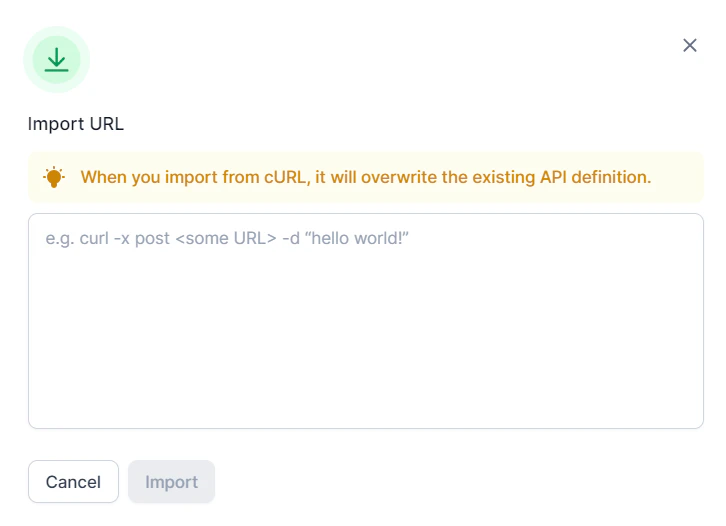
-
Enter a Sample Input and click Run.
.png?fit=max&auto=format&n=y4Bk69IPfyYQR_ri&q=85&s=1e43a03c67f69768290aab1255298f28)
-
Output Fields are displayed. Close the pop-up. The ID resolver is now displayed.
.png?fit=max&auto=format&n=y4Bk69IPfyYQR_ri&q=85&s=6be023dffdca03d2c0cceafa5afc6353)
- Click Continue.
.png?fit=max&auto=format&n=y4Bk69IPfyYQR_ri&q=85&s=b315d330e57e5c9df22eb2cfb4ee6ac7)
-
On the field value resolver or field meta resolver pop-up, toggle Use Dictionary.
.png?fit=max&auto=format&n=y4Bk69IPfyYQR_ri&q=85&s=6dd5a64f4b96d61146aec72bca7af965)
- Click + Create.
-
On the Name & API tab, enter the dictionary name, API call details, and pagination details if required.
.png?fit=max&auto=format&n=y4Bk69IPfyYQR_ri&q=85&s=13a8e77c811fa016c0c82483851b2d8f)
- Click Run API. The Field Selection tab is displayed.
-
Select the fields to be searched, the ID resolver field, the Schedule to Pool data frequency, and the meta resolver field.
.png?fit=max&auto=format&n=y4Bk69IPfyYQR_ri&q=85&s=9374134517beb902627dcc74fe734ab3)
- Click Pool data into the dictionary. The Preview tab displays the pooled data.
- Click Done. The dictionary is saved.
- Click + Create URL.
-
Enter a static URL (for example,
https://team.atlassian.net/browse/). -
In the Variable Mapper, select the dynamic key from the response object.
.png?fit=max&auto=format&n=y4Bk69IPfyYQR_ri&q=85&s=781229bd83319073fb80f10bc000bb93)
- Click Done. Click Continue.
.png?fit=max&auto=format&n=y4Bk69IPfyYQR_ri&q=85&s=574bcaaaa111444c330e447123701760)
Step 4.3: Query Filters
Field Filters Define which fields are available for querying and filtering:- In the Allow Query column, select queryable fields (all are selected by default).
- Check Allow multiple values for fields that support multi-value queries.
- Check Mandatory for fields that users must specify before data is returned. This option is disabled if the corresponding Allow Query field is not selected.
- Edit Field_Filter_Key if the key differs between push and retrieval operations. Keys are generated based on the API response.
- Click Configure to generate sample queries based on the field filter settings.
- Click Upload API documentation, paste the API documentation, and click Save. Query parameters are auto-populated.
- Click Sample Query to extract variables.
-
Build the API payload based on the API type:
- GET: Configure the query parameters section (editable inline). Add additional parameters as needed.
- POST: Configure the body payload.
Ensure the configuration includes only variables in place of entities. This allows APIs to be dynamically generated at runtime. - Click Run to generate the configuration builder script. The script runs on the sample query and displays the API response.
- Click Run Queries to test all generated queries. Success or error messages are displayed per query.
- Optionally, click Script to view and edit failed queries. You can proceed without fixing — only successful and similar queries will work after publishing.
- Click Continue.
- Entity Rule: Automatically adds entities to queries when specific keywords are detected. Example: Interpreting “active deals” as deals in stages “presentation,” “working progress,” or “contract in progress.”
- Answering Rule: Controls and customizes responses when specific conditions are met. Example: Responding with “contact sales” for any pricing-related questions.
Step 4.4: Sample Queries
Sample queries are auto-generated based on the system’s purpose. Users click them to execute associated actions. Add custom queries using + Add Query. Click Continue.Step 5: Business Rules
Set account-level entity and answering rules for the agent. See Business Rules within Actions above for rule type descriptions.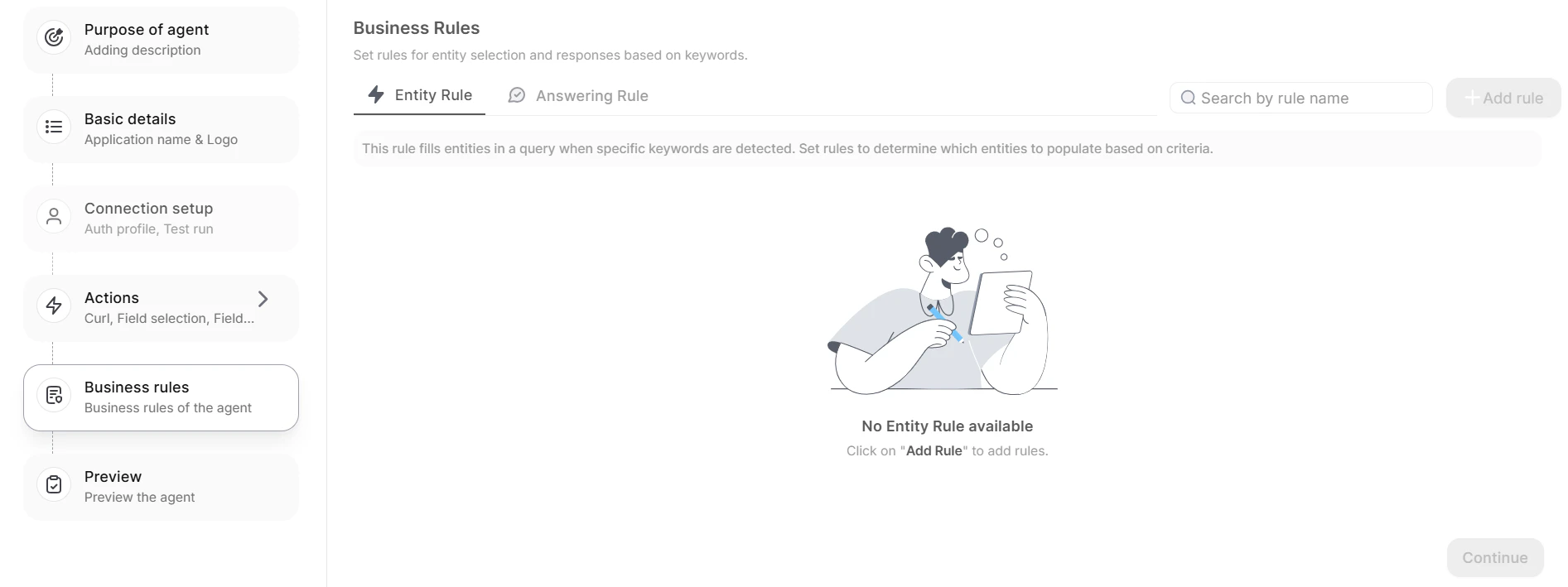
Step 6: Publish
See Publishing Your Agent.Writing API Payloads with JavaScript
The configuration script is an IIFE invoked for each query with three arguments:- queryParams: Array of objects —
{ key: 'jql', value: '...', enabled: true }. Elements withenabled: falseare ignored. - headers: Same structure as
queryParams—{ key: 'Content-Type', value: 'application/json', enabled: true }. - body: The JSON payload expected by the API.
entities:
| Query Type | Available Fields | Example |
|---|---|---|
| Simple (text, object, select) | value | creator: { filterKey: 'creator', dataType: 'object', value: '080-998df-ffal-9090' } |
| Range (date, number) | min, max, value | amount: { filterKey: 'amount', dataType: 'number', min: 20000, max: 50000 } |
| Multiple values | values[] | assignee: { filterKey: 'assignee', dataType: 'object', values: ['9f0990-009-lklkl', '9099-ff-kll-9090'] } |
User Interaction
Users query the API Agent in natural language. The agent processes queries and returns structured data. Users can refine queries for more specific results. For example, “Get hotel data” or “Display guest information with check-in after March 1” returns filtered, formatted results.Search Agents
Search Agents (also called RAG Agents) combine retrieval and generation techniques to provide accurate, contextually relevant answers. They retrieve information from connected knowledge bases and use LLMs to generate precise responses. Integration options:- Search AI: Configure and index content from knowledge bases, files, and websites. Use when you need full control over content sources within your environment.
- Amazon Q: Index enterprise data in your AWS cloud using 90+ connectors for AWS and non-AWS systems. Provides comprehensive search while maintaining data sovereignty.
For use cases where a search index should act as the default knowledge repository without intent-based routing, connect it via Enterprise Knowledge instead.
Prerequisites
For Search AI:- Create a Search AI application.
- Configure content sources.
- Fine-tune search settings.
- Enable Answers.
- Train the application.
- Enable the Client Channel with the appropriate API scopes: Answer Generation, Permission Entity Management, Document Management, and Facets.
- An existing Amazon Q Business application with indexed enterprise content
- Appropriate AWS credentials and permissions
- Access to AWS data accessor configuration details
Create a Search Agent
Navigate to Admin Console > Search Agents, then click Create Agent.Step 1: Details and Purpose
Provide a unique Name and brief Purpose. The purpose enables the Orchestrator to route user queries to this agent. For example, if the agent answers HR policy questions, specifying this ensures the agent activates on HR-related queries.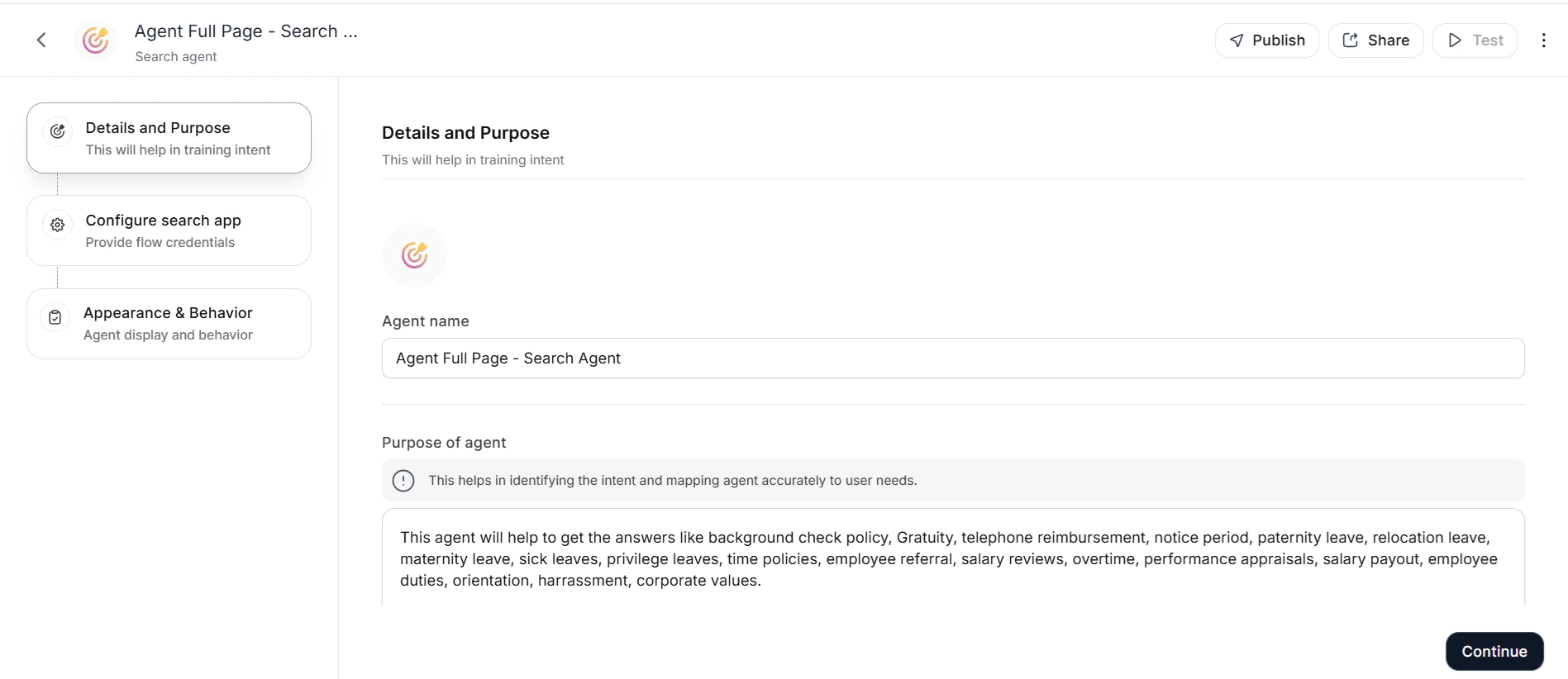
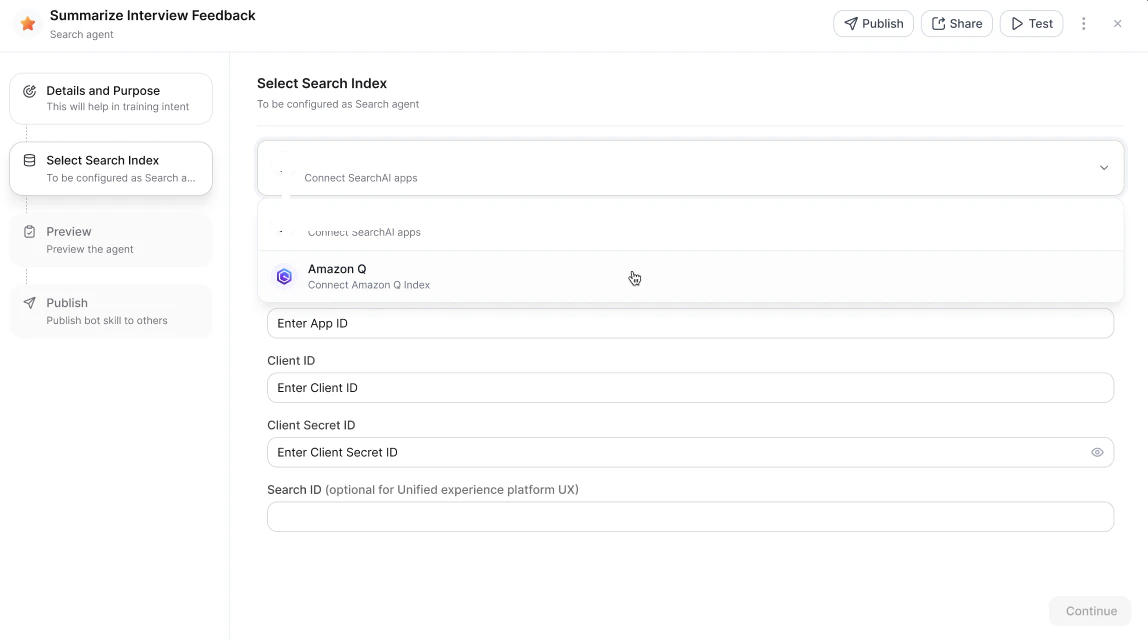
Step 2: Configure Search Index
Select your search solution in Search Index Options. Option 1: Search AI Provide the following details (available in the Search AI app under Manage > Dev Tools > Web/Mobile SDK). See Web/Mobile SDK documentation for details.| Field | Description |
|---|---|
| URL | Search AI instance URL where the application is hosted |
| App ID | Application ID of the Search AI app |
| Client ID | Client credentials generated for interaction with the RAG Agent |
| Client Secret ID | Secret key generated for secure interaction |
| Search ID | Unique client identifier generated in Search AI |
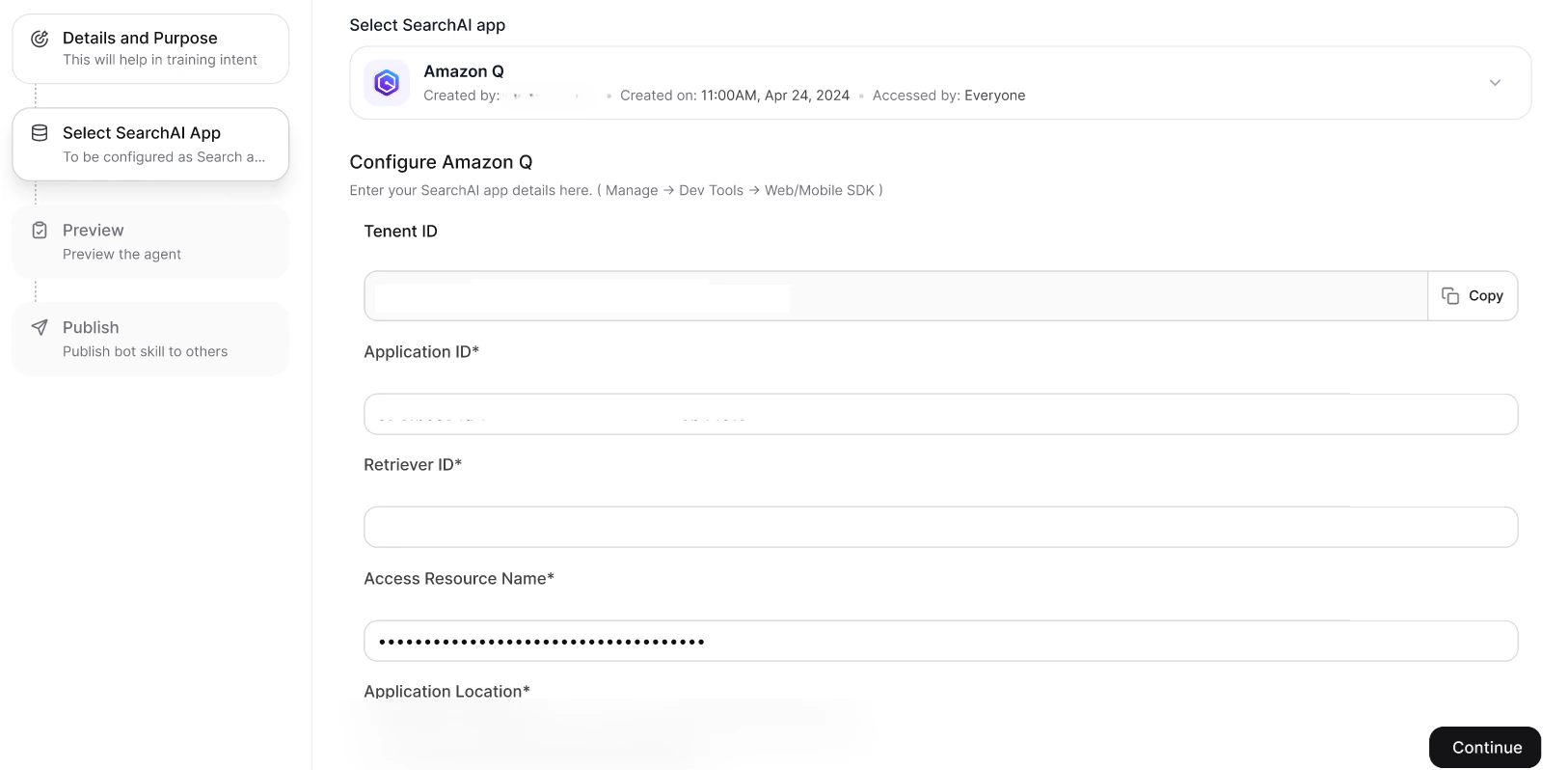
| Field | Description |
|---|---|
| Application ID | Unique identifier of your Amazon Q Business application |
| Retriever ID | Unique identifier of your Amazon Q Business retriever |
| Access Resource Name | ARN for secure access to Amazon Q resources |
| Application Location | AWS region where your Amazon Q Business application is deployed |
| IDC Location | AWS region where your AWS Identity Center instance is located |
Step 3: Appearance and Behavior
Review auto-generated sample queries. Click + Add Query to add more. Enable Clear End-User Chat History to delete chat history after a specified period. Click Publish to proceed.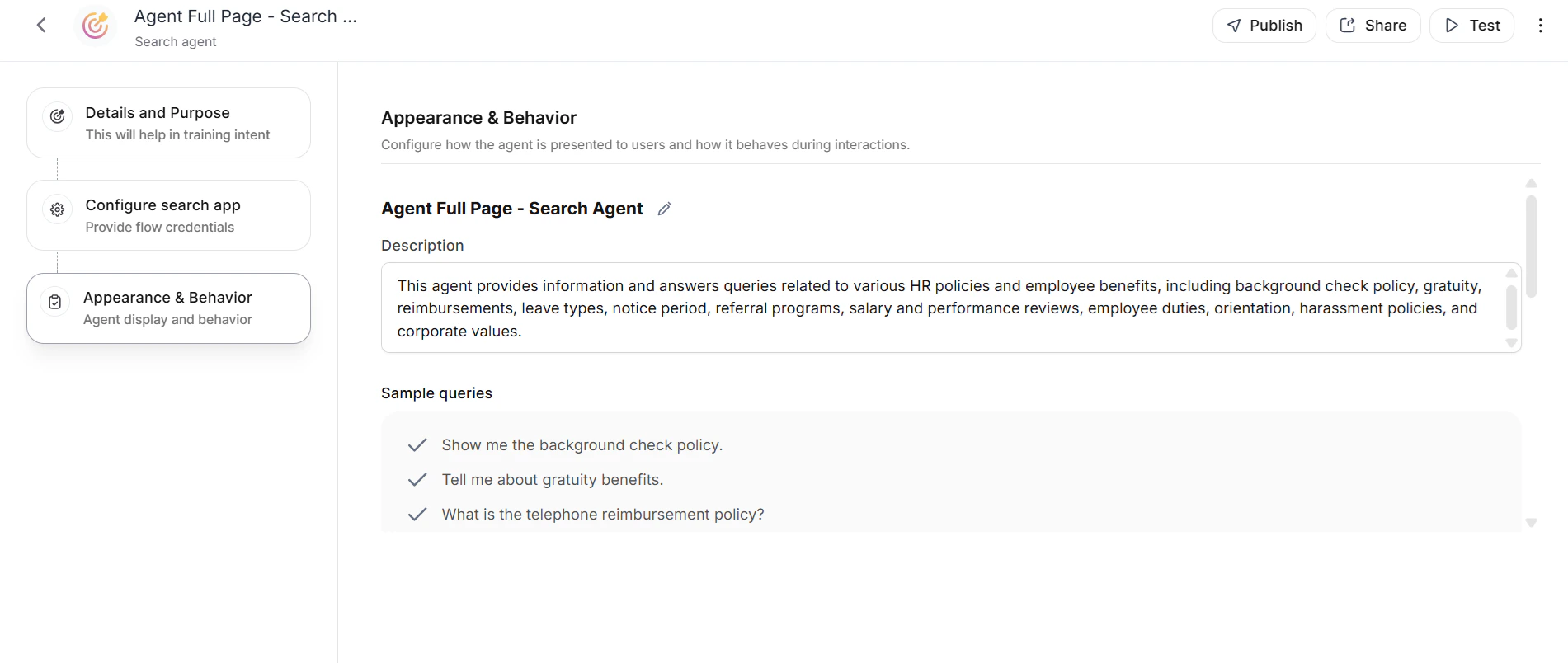
Step 4: Publish
See Publishing Your Agent.Agentic Flow Agents
Agentic Flow enables the sequential execution of multiple AI agents to automate complex tasks. These flows streamline workflows by automating interactions and decision-making processes based on predefined logic and user input.Create an Agentic Flow Agent
Navigate to Admin Console > AI Agents > Agentic Flow, then click +Create Agent.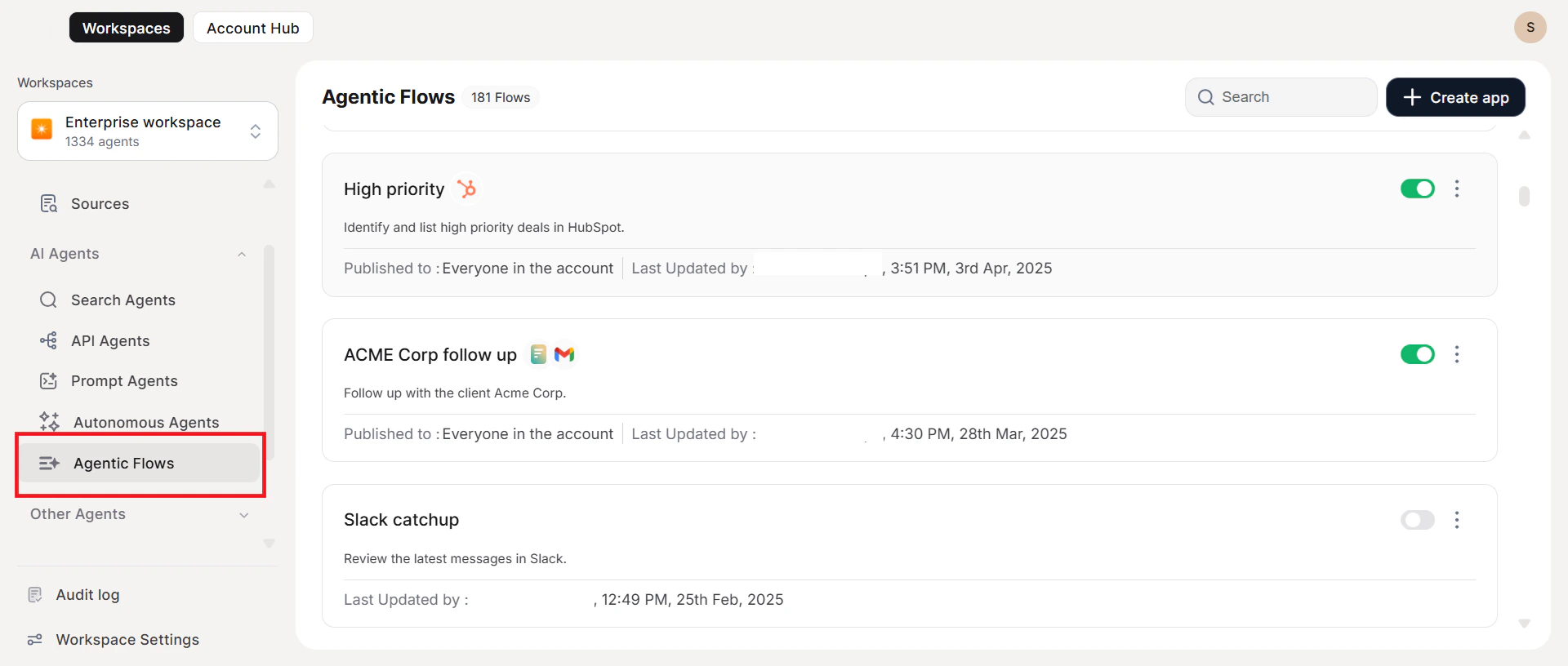
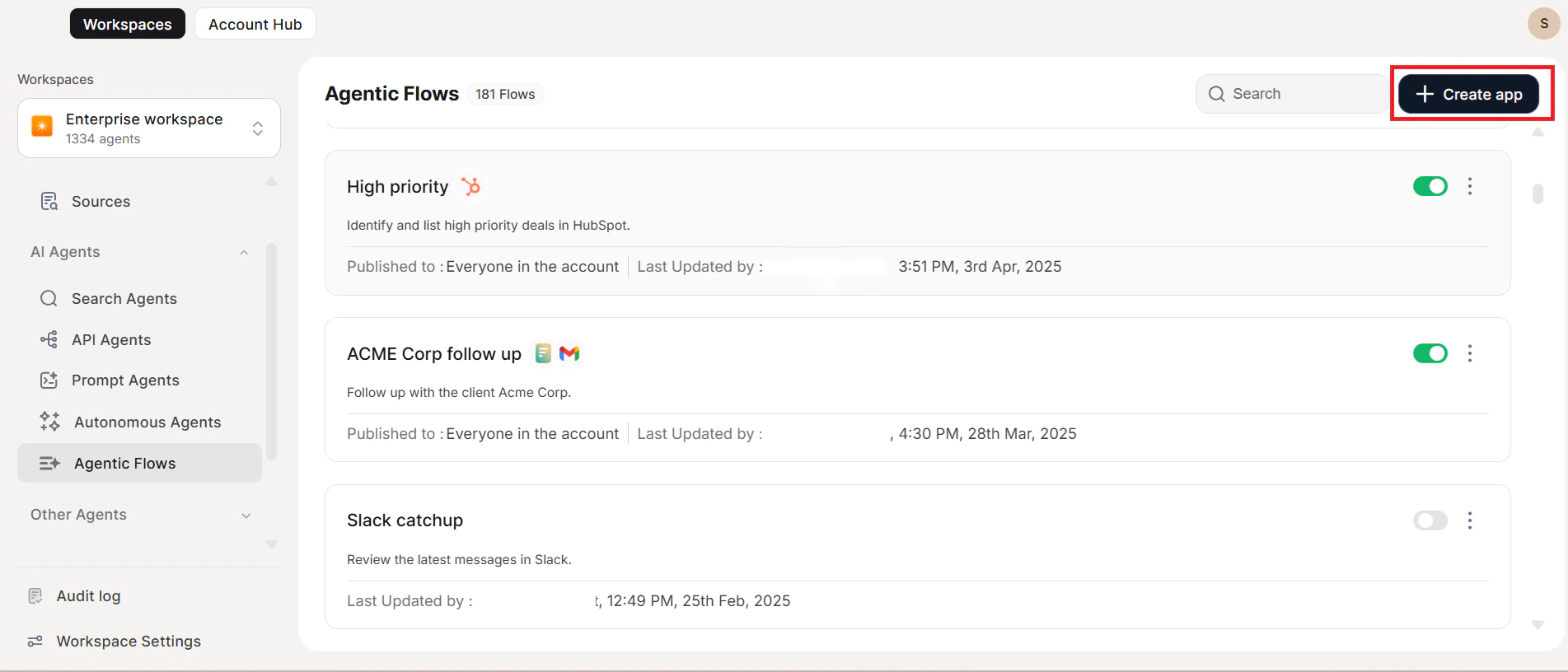
Step 1: Details and Purpose
- Agent Name: Enter a unique, meaningful name.
- Purpose: Defines the intended functionality for query routing and training. Specifies the default prompt and sample queries for accurate routing.
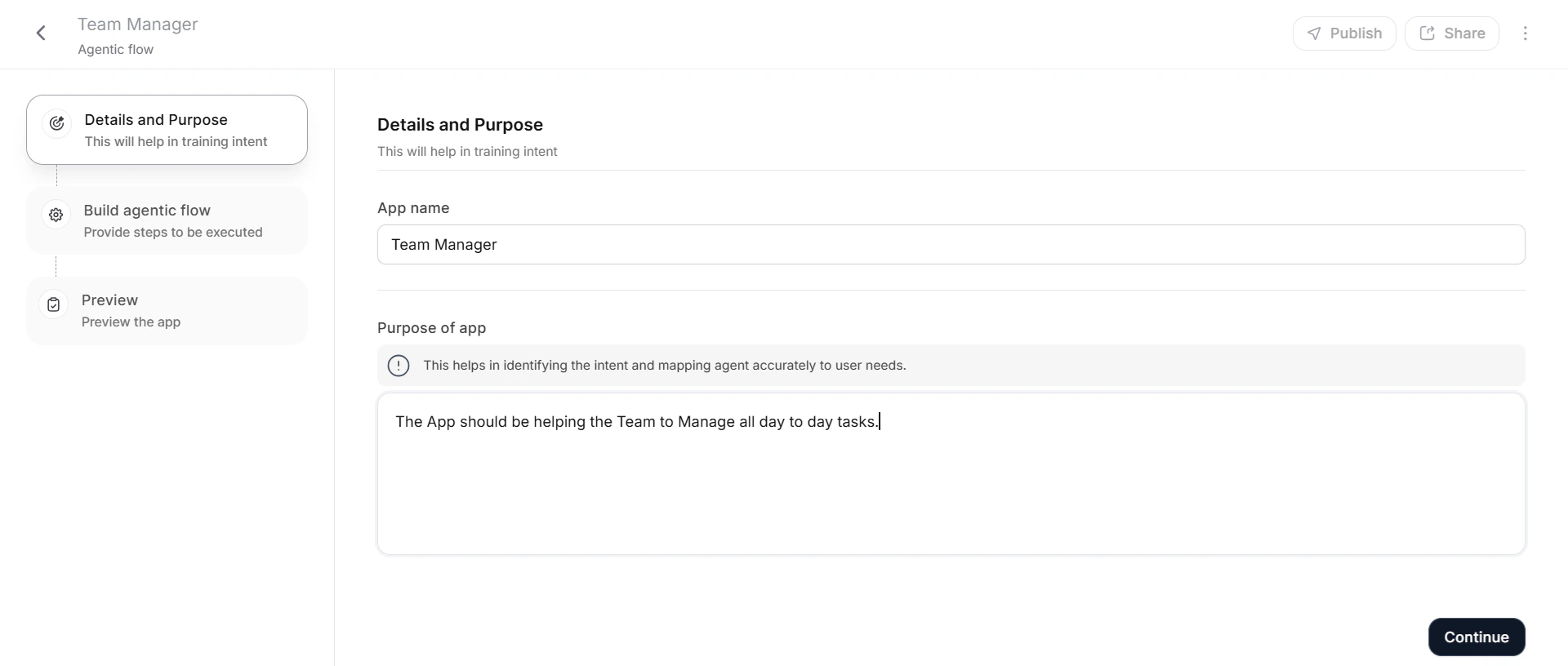
A well-defined purpose enhances the agent’s ability to correctly interpret and execute tasks, ensuring precise responses to user queries.
Step 2: Build Agentic Flow
- Review the auto-generated Prompt based on the agent’s purpose. The system auto-generates workflow steps. For example, a financial advisor workflow might include: perform research, check who owns the shares, and decide to sell or hold based on research.
- Click Get Flow to review the generated flow.
- Customize your flow:
- Add a step: Click + Add above or below any existing step.
- Edit or delete a step: Hover over the step and select the edit or delete option.
- Reorder steps: Drag and drop steps to the desired position.
- Click Run to execute all configured steps sequentially.
- Click Continue.
Step 3: Appearance and Behavior
Review auto-generated sample queries. Click + Add Query to add more. Enable Clear End-User Chat History to delete chat history after a specified period. Click Publish to proceed.Step 4: Publish
See Publishing Your Agent.Example: Finance Advisor
The Finance Advisor demonstrates a four-step Agentic Flow:| Step | Agent Type | Action |
|---|---|---|
| 1. Market Analysis Overview | Search (RAG) Agent | Analyzes NVIDIA market performance from indexed files, evaluating market indicators and historical patterns |
| 2. Company Share Owners | API Agent | Retrieves shareholder information from the client database (institutional investors, individual stakeholders, portfolio allocations) |
| 3. Client Information and Risk | Prompt Agent | Performs risk evaluation and develops hold/sell recommendations based on consolidated data from previous steps |
| 4. Compose an Email | Prompt Agent | Generates a professional email synthesizing all analyses and recommendations |
The generated email can be edited and customized before sending to meet specific communication requirements and organizational standards.
Autonomous Agents
Autonomous Agents are AI-powered agents that leverage Agent Platform to autonomously manage complex business tasks and workflows. They use adaptive algorithms for dynamic decision-making, responding to evolving business requirements in real time.Create an Autonomous Agent
Navigate to Admin Console > AI Agents > Autonomous Agents, then click +Create Agent.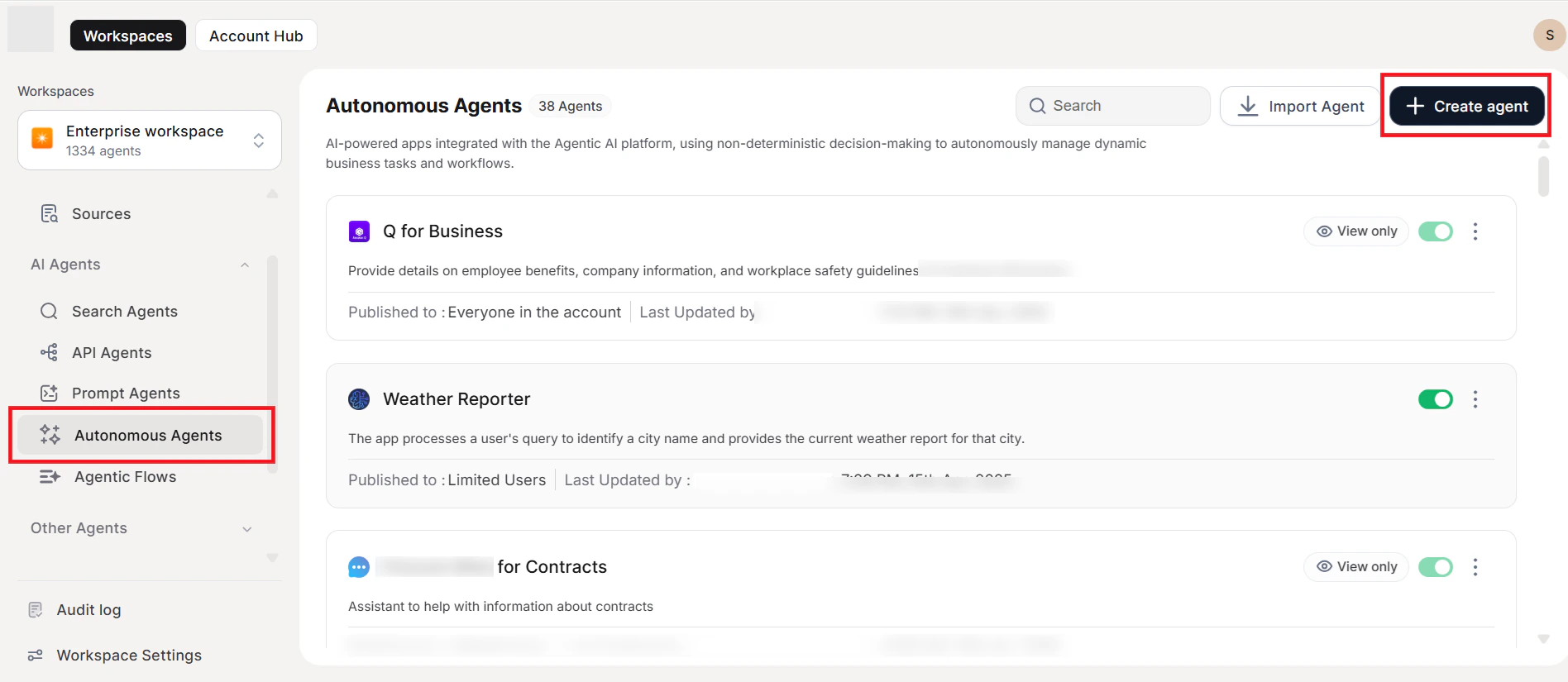
- Icon: Choose from the predefined library or upload a custom icon.
- Agent Name: Enter a unique, meaningful name.
- Purpose of Agent: Define the intended functionality for query routing and training.
| Mode | Description | Requirements |
|---|---|---|
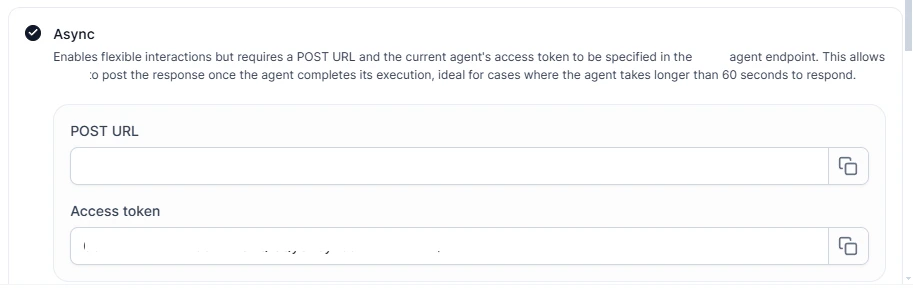
| Sync Mode | Immediate responses; 60-second timeout | No POST URL or access token required |
| Async Mode | Flexible; suitable for tasks taking longer than 60 seconds | POST URL and access token required in the Autonomous agent endpoint |
| Field | Description |
|---|---|
| URL | Endpoint URL of the agent obtained from Agent Platform |
| Method | Request type (GET, POST, etc.) |
| Headers | Authentication tokens and request metadata; add multiple as needed |
| Query String | Additional URL parameters for filtering or customization |
| Body Type | Data format (JSON, Raw, etc.) |
| Content Type | Data type label for the API |

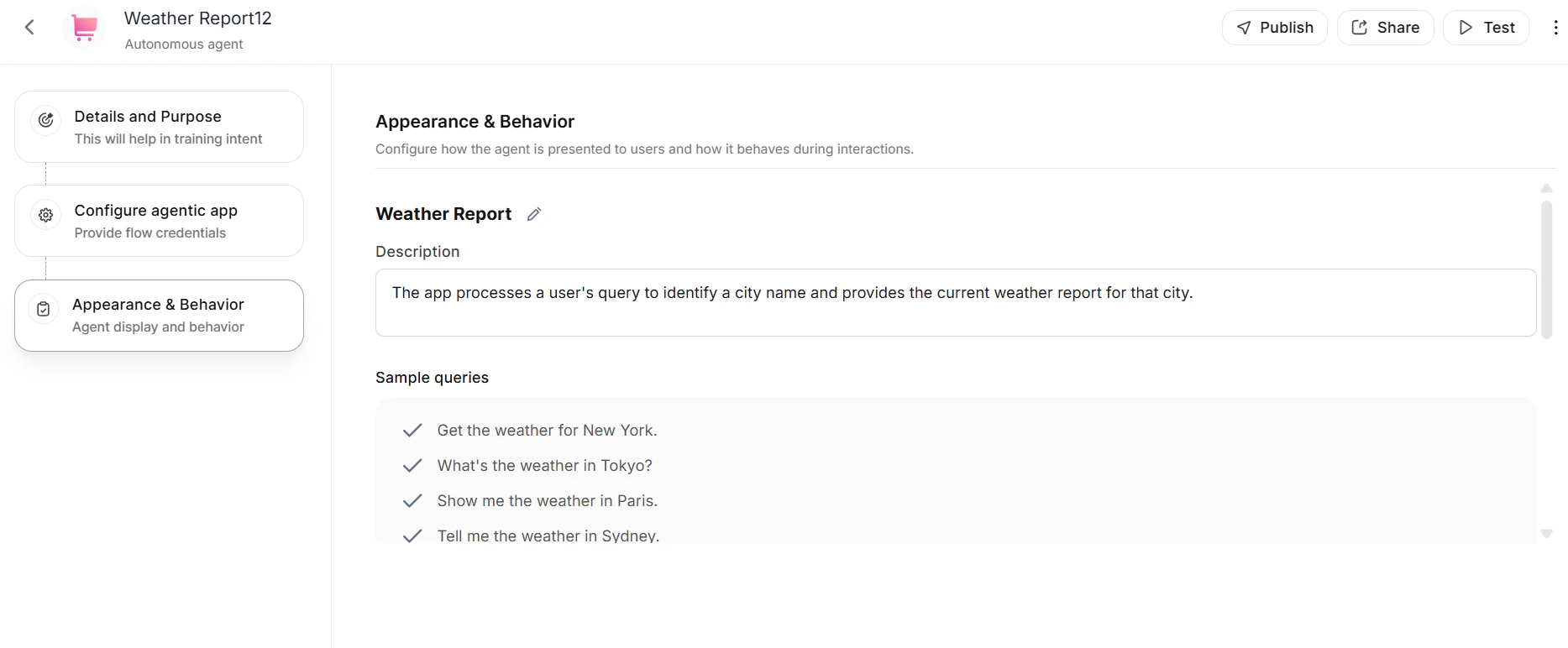
- Click +Add Query to add test queries.
- Enable Allow End User Notification to enable notification configuration and agent trigger setup. See Notifications.
- Enable Clear End-User Chat History to delete chat history after a specified period.
- Click Publish to proceed.
Import an Existing Autonomous Agent
- Click Import Agent in the upper-right corner.
- Select the
.ZIPfile of the existing agent. - Click Import. The agent appears on the Autonomous Agents page.
You cannot directly import agents exported from Agent Platform. Only Autonomous Agents originally created and exported from the application can be imported using this feature.
Usage
Trigger an Autonomous Agent from the Compose bar > Agents > agent tab. Users engage in natural conversations — the agent understands context, processes requests, and provides relevant responses based on its configured capabilities.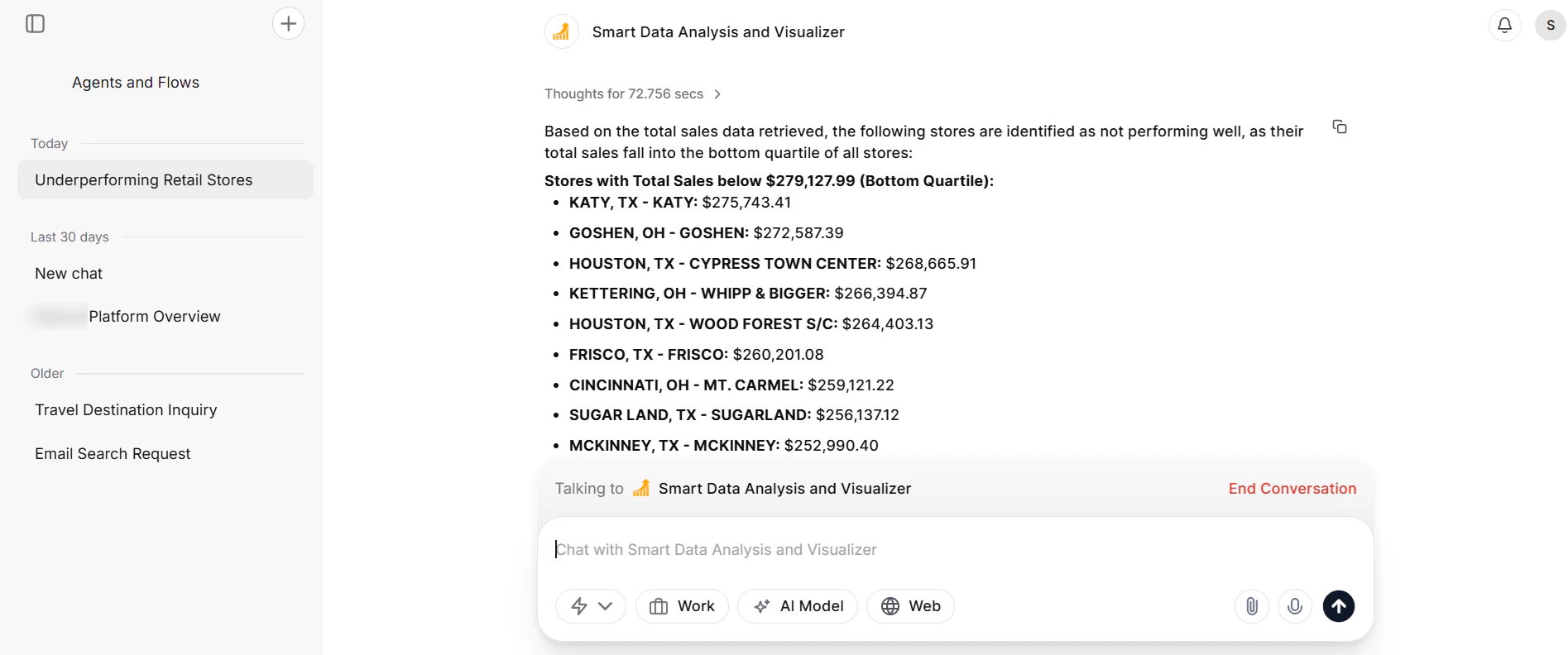
Bot Agents
Administrators create Bot Agents for users using the bot agent builder. Workflows designed on the AI for Service Platform integrate seamlessly, allowing actions to execute when a workflow triggers — without requiring additional platforms. For complex workflows involving multiple system integrations and logic, users build bots on the AI for Service Platform and trigger them through conversational UI or NLP intent. Example: A Fund Transfer Bot Agent automates fund transfers to client accounts, capturing client names, account information, and transfer amounts through natural conversation.Import an Existing Bot Agent
-
Click Import Agent in the upper-right corner.

-
Select the
.ZIPfile of the existing agent.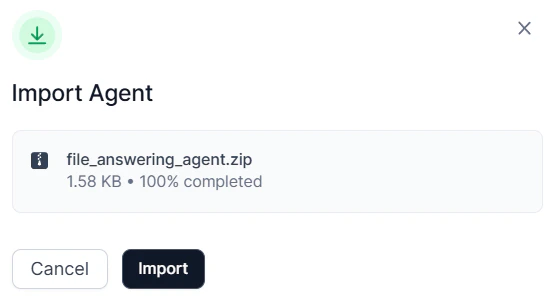
- Click Import. The agent appears on the Bot Agents page.
Create a Bot Agent
Navigate to Admin Console > AI Agents > Bot Agents, then click +Create Agent.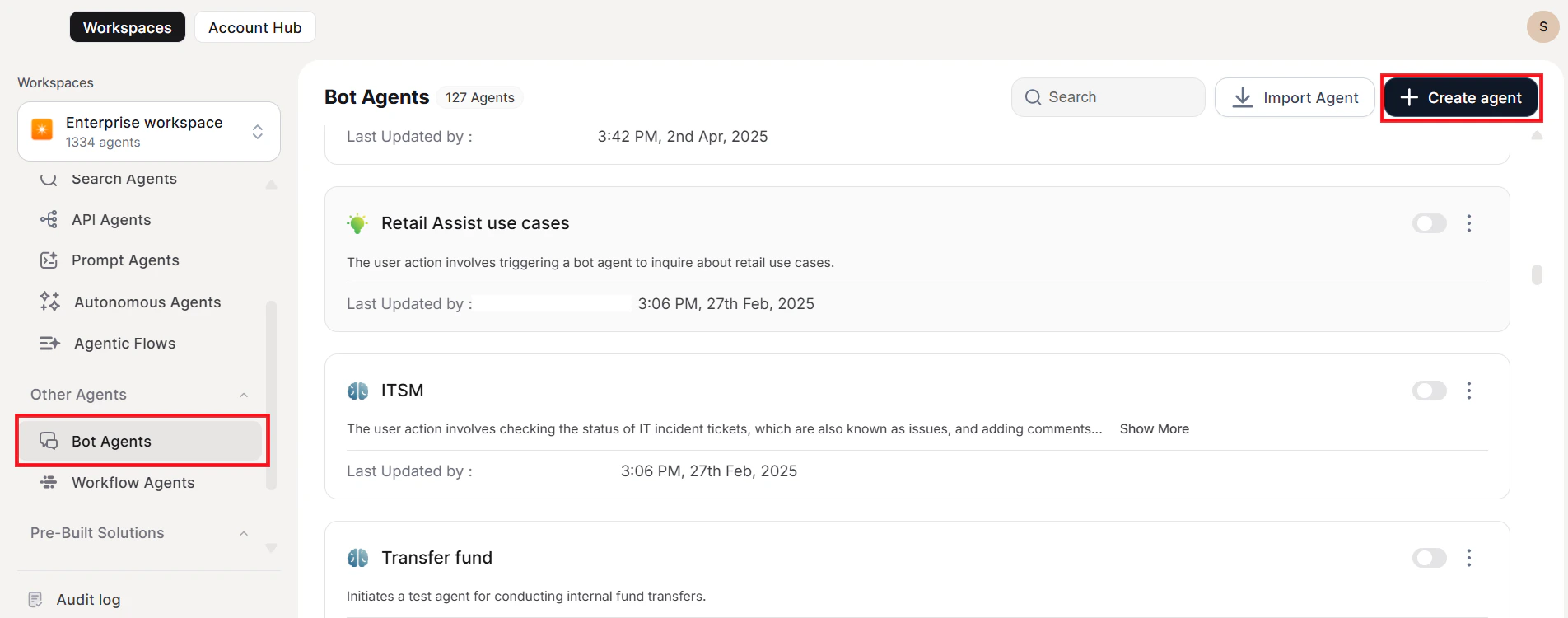
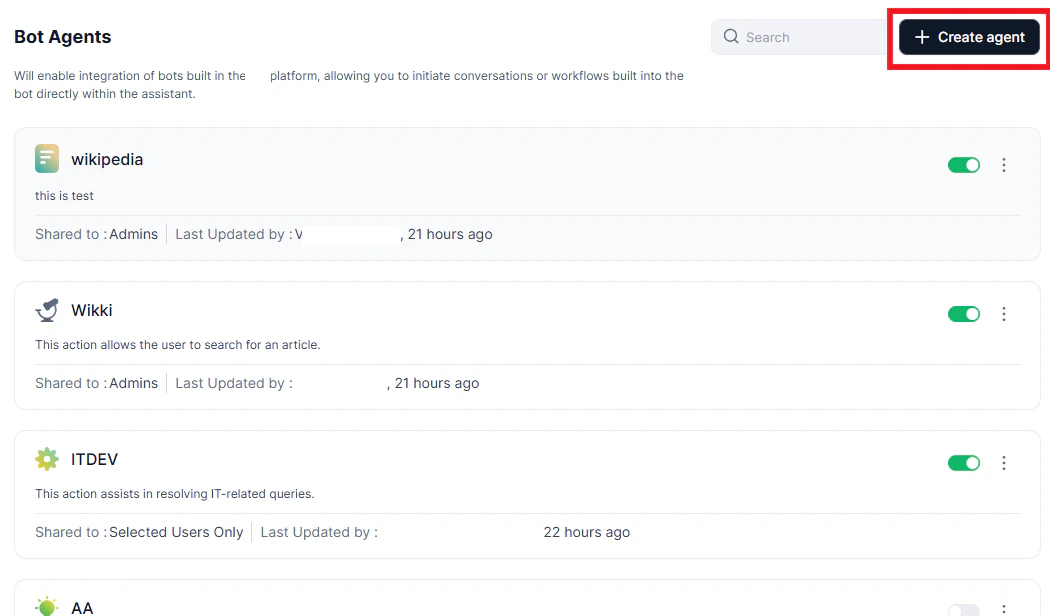
You must first build a bot on the AI for Service Platform and create a webhook channel. See Building a Virtual Assistant and Add Webhook Channel.
- In the AI for Service Platform, open your virtual assistant. Navigate to Deploy > Channels > Add More > Webhook.
-
Select the required app from the Webhook dialog.
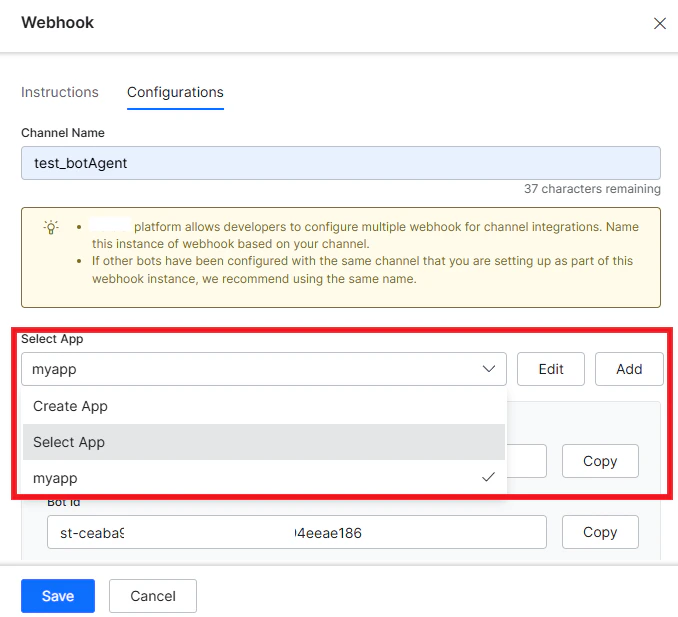
-
Copy the Bot client ID and Bot secret ID for use in Step 2 below.

- Under Configured Channels, click the bot name and enable the channel.
Create a new client app using the JWT tokens generated from the Post URL and Access tokens available in the Add Bot section.
Step 1: Details and Purpose
Provide a unique name and describe the agent’s purpose. The purpose enables the agent to recognize its capabilities and respond to aligned user queries.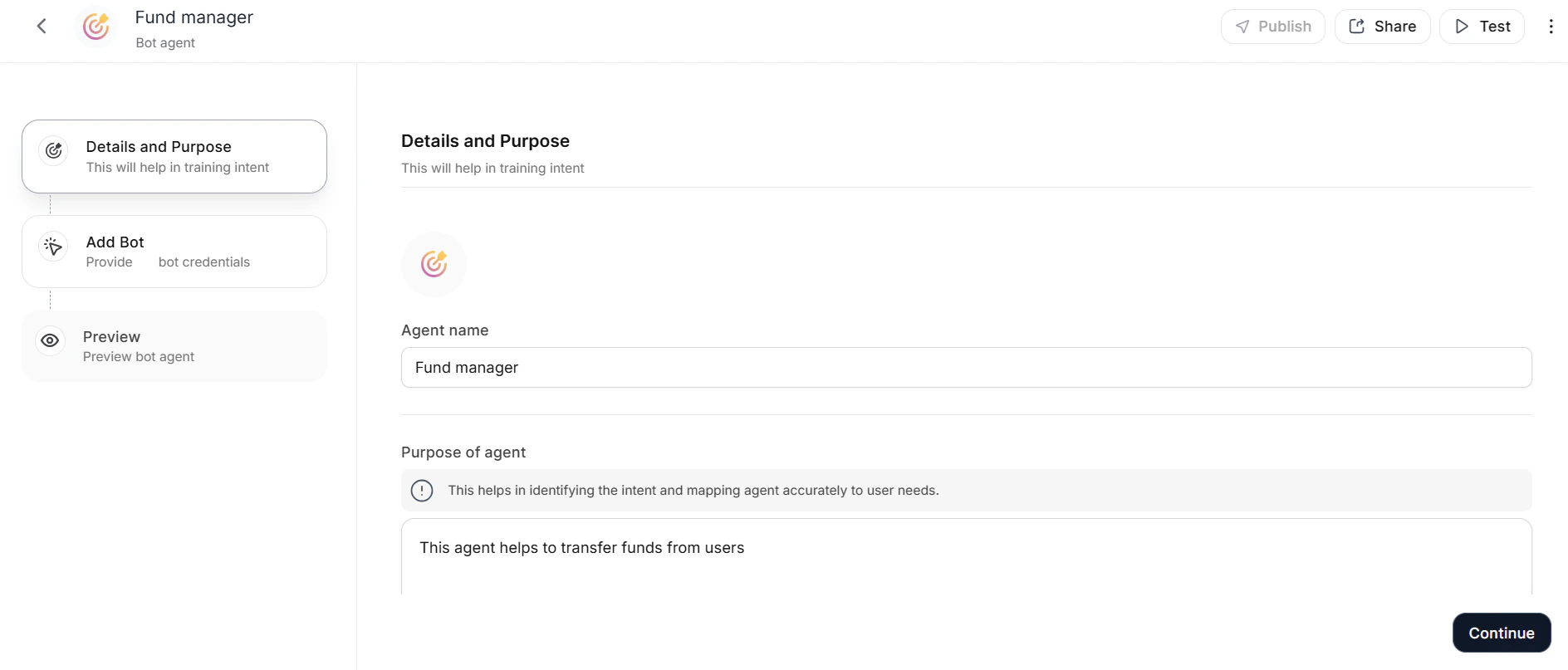
Step 2: Add Bot
-
Enter the following in the Add Bot section:
- Post URL: API endpoint (auto-populated).
- Access Token: Authentication token (auto-populated).
- Webhook URL: URL from the Bot Webhook dialog.
- Bot client ID: Copied from the Bot Webhook dialog.
- Bot secret ID: Copied from the Bot Webhook dialog.
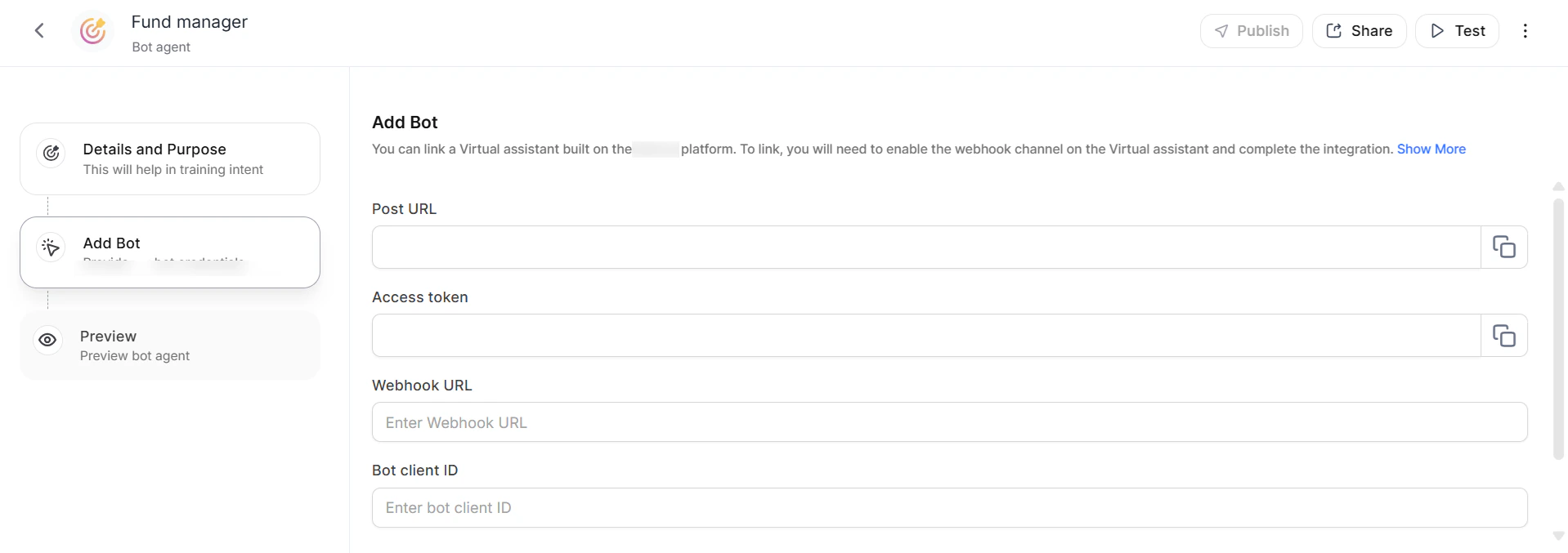
- Click Connect account.
Step 3: Appearance and Behavior
- Click +Add Query to add test queries.
- Enable Allow End User Notification to enable notification configuration. See Notifications.
- Enable Clear End-User Chat History to delete chat history after a specified period.
- Click Publish to proceed.
Step 4: Publish
See Publishing Your Agent. The agent appears in the Agents list on the Agents page.On the Agents list page, click the three-dots icon next to the agent’s name to publish the agent at a later time if needed.
User Interaction
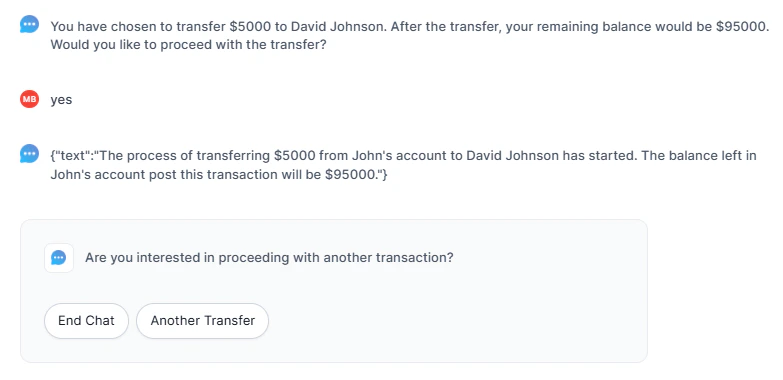
Users initiate conversations by typing a command. The bot guides users through required steps, capturing key details (for example, client name, account information, and transfer amount for a fund transfer). The bot confirms task completion or provides a status update.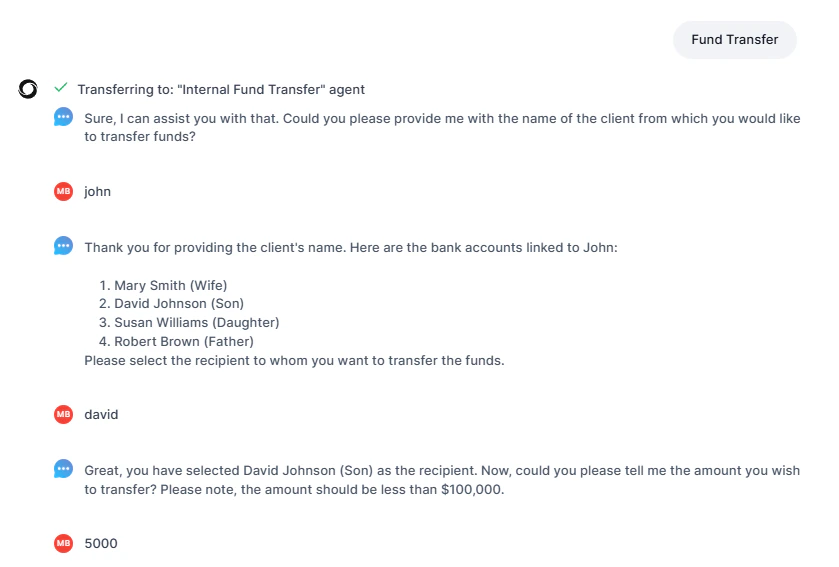
- Alert API — Integrate conversation hold and resume functionality within AI for Service Bots.
- Notify API — Send interactive notifications to users.
Workflow Agents
Workflow Agents integrate tools from Agent Platform to deliver contextually relevant responses in real time. They combine APIs, retrieval, and generation techniques, and support both synchronous and asynchronous interactions.Import an Existing Workflow Agent
-
Click Import Agent in the upper-right corner.

-
Select the
.ZIPfile of the existing agent.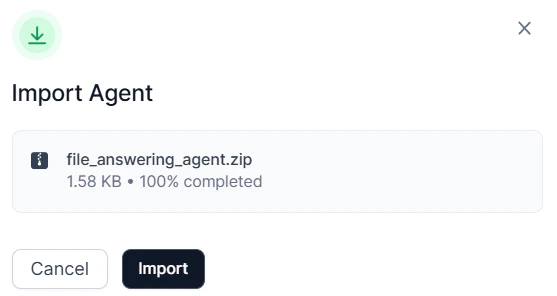
- Click Import. The agent appears on the Workflow Agents page.
Create a Workflow Agent
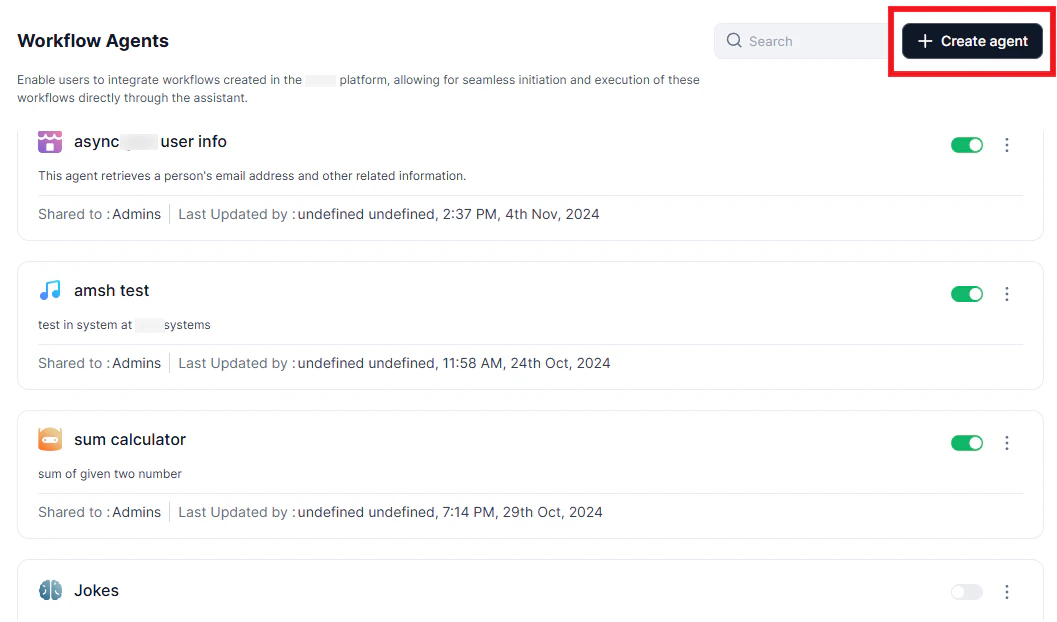
Navigate to Admin Console > AI Agents > Workflow Agents, then click +Create Agent.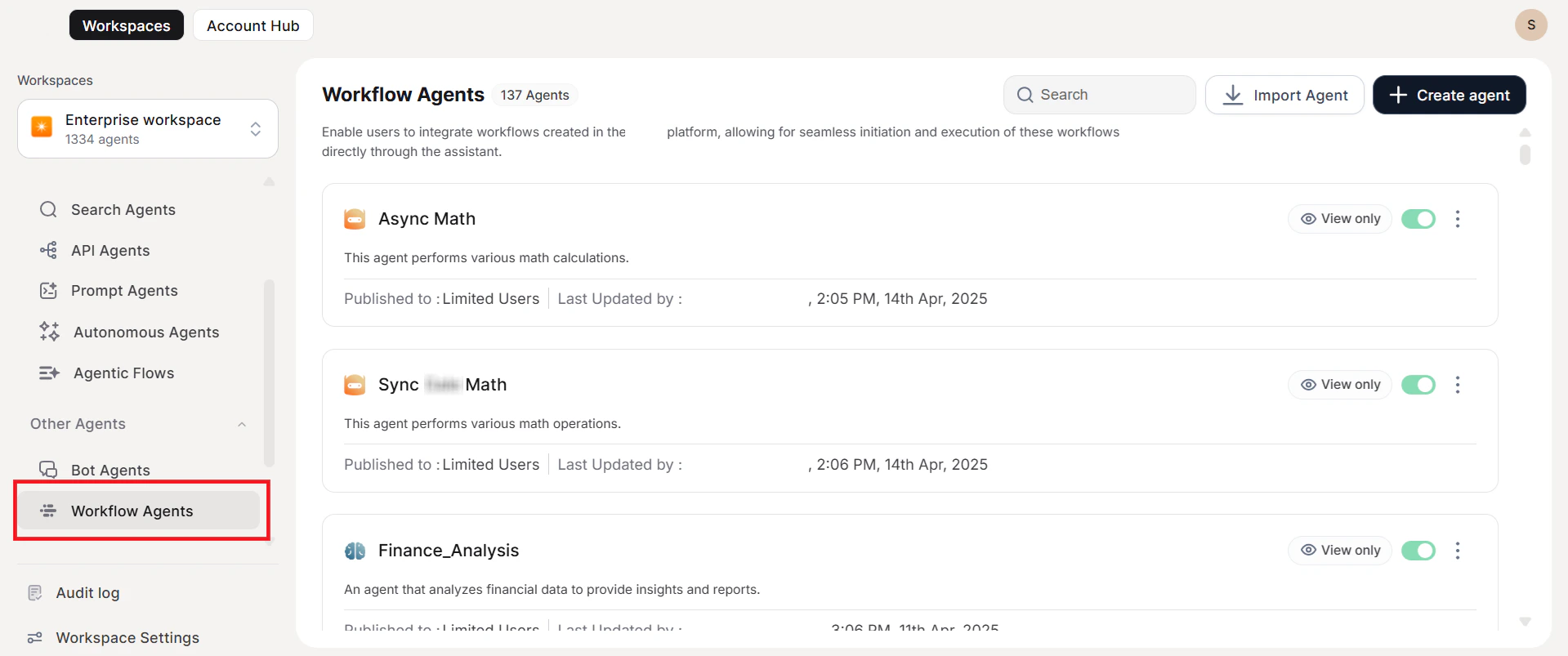
Step 1: Details and Purpose
Provide a unique name and describe the agent’s purpose. For example, an agent named “Sales Buddy” handling cross-sell and upsell queries should specify this purpose so it activates for related user queries.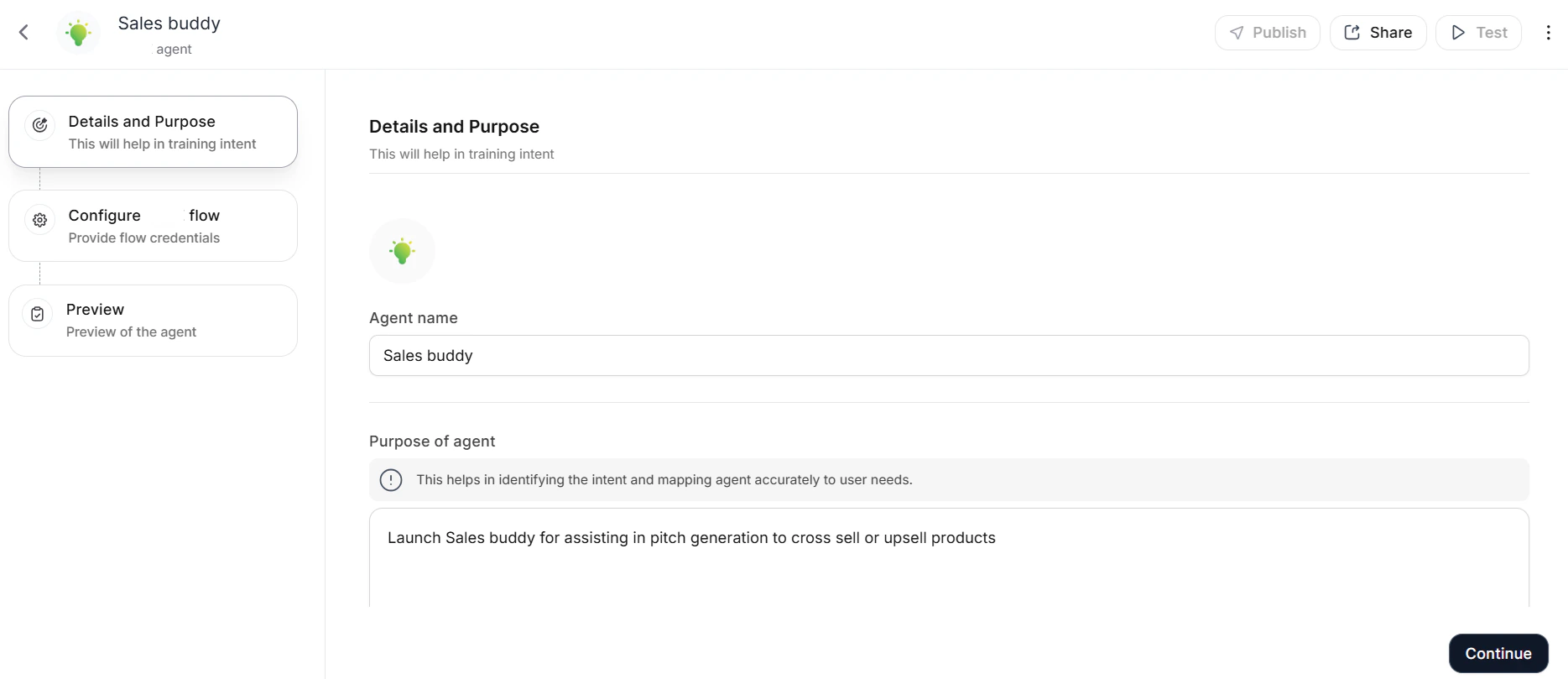
Step 2: Configure Workflow Flow
Select the interaction mode:| Mode | Description | Timeout |
|---|---|---|
| Sync Mode | Immediate responses | 60 seconds |
| Async Mode | Flexible; suitable for tasks taking longer than 60 seconds | No fixed timeout |
- In the Workflow Platform, open the agent and click Agent endpoint in the left navigation.
-
Select Async push and click the settings icon.
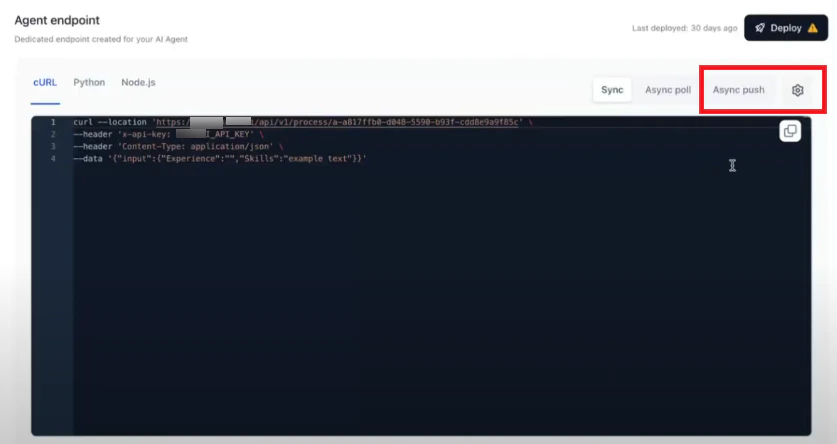
- Paste the POST URL and Access Token into the Sync/Async mode setup page.
- Click Save.
- On the Define API page, click CURL Import.
- In the Workflow Platform, navigate to the agent’s Agent endpoint and copy the appropriate cURL (sync cURL for sync mode, async cURL for async mode).
- Paste the cURL into the Import URL dialog and click Import.
- Click Run to fetch API details.
- Retrieve the API key: in the Workflow Platform, go to API Keys > Create new key > Generate Key, then click Copy and Close.
- Paste the API key into the API key value field and click Continue.
-
Review the API response output keys — these map to the values displayed to end users.
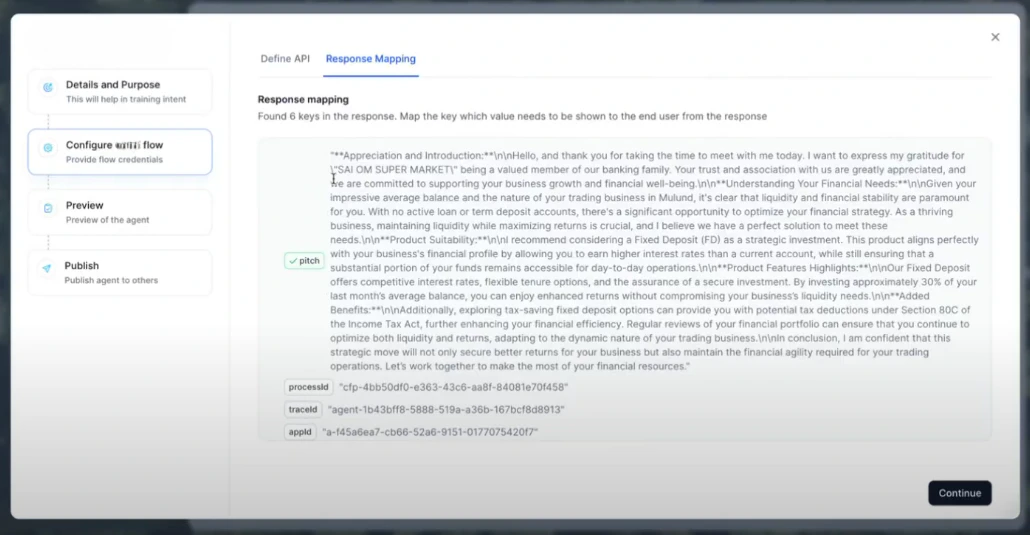
- Click Continue.
Step 3: Appearance and Behavior
- Click +Add Query to add test queries.
- Enable Allow End User Notification to enable notification configuration. See Notifications.
- Enable Clear End-User Chat History to delete chat history after a specified period.
- Click Publish to proceed.
Step 4: Publish
See Publishing Your Agent.Manage Input and Output
Agent Flows use input and output variables to control data flow:- Input Variables: Provide initial data to the agent flow.
- Output Variables: Store and return derived values from the flow. Define output variables to capture the results you want the agent to return.
User Interaction
Sync Mode: Users enter a query and receive real-time results in the current interface. Ideal for requests completable within 60 seconds. Async Mode: Users enter a query and receive results via notification once processing is complete. Suited for complex queries that require more than 60 seconds.MCP Agents
MCP Agents enable AI agents to interact with external systems through tools hosted on Model Context Protocol (MCP) servers. By configuring MCP tools, agents can execute complex workflows spanning multiple external services through a standardized interface.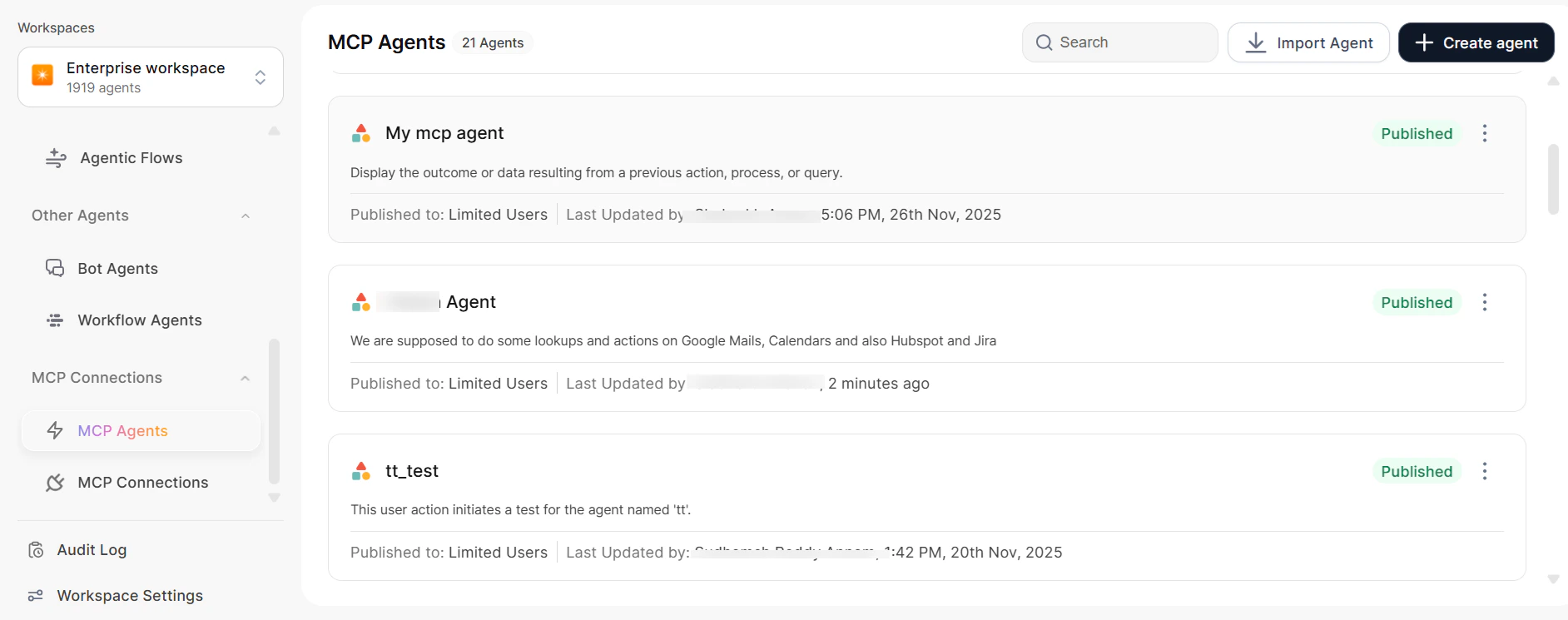
How MCP Agents Work
MCP Agents use the Model Context Protocol to discover, select, and invoke tools from connected MCP servers:- Tool Discovery: During MCP server configuration, the MCP Client discovers available tools on the server, enabling the application to learn server capabilities. You then assign these tools to agents for dynamic decision-making.
- Intent Detection: When a user sends a query, the system sends the tool list and query to the LLM for intent detection and tool invocation. The LLM identifies the tool to use and forms a structured tool call.
- Tool Invocation: The MCP Client sends a structured request to the MCP Server with the tool name and required parameters.
- Execution: The MCP Server executes the tool logic and sends results back to the MCP Client.
- Response Generation: The agent uses the tool’s output to formulate a natural language response via the LLM.
Create an MCP Agent
Navigate to MCP Connections under your Workspace, then click Create Agent.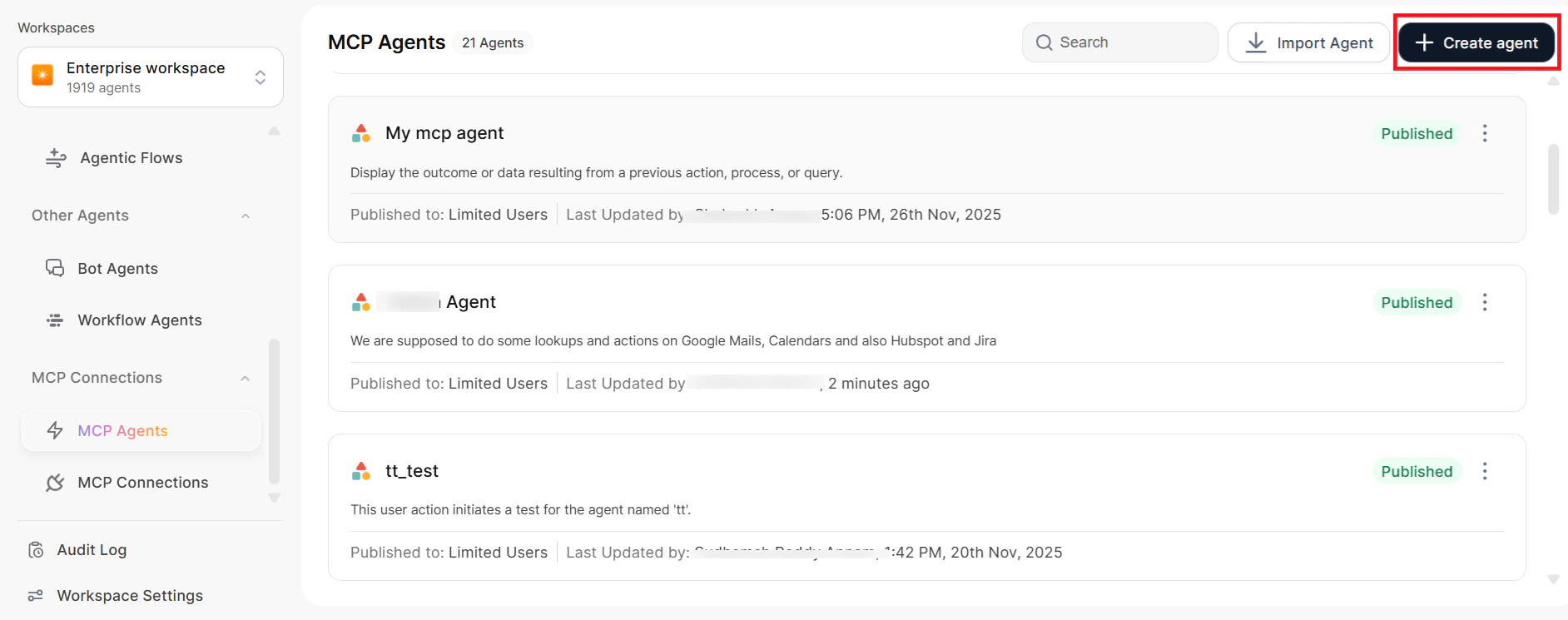
- Define the agent’s details and purpose:
- Icon: Choose from the predefined library or upload a custom icon.
- Agent Name: Enter a unique, meaningful name.
- Purpose of Agent: Define the intended functionality for query routing and training.
- In the Configure MCP section, the platform displays all tools available from both workspace and account connections.
- Select the specific tools you want the agent to use.
- Configure each tool’s input parameters (see Configuring Tool Parameters).
- (Optional) Business Rules: Set entity or answering rules triggered by specific keywords.
- Click Save and Publish.
Configuring Tool Parameters
Each MCP tool requires specific input parameters. Configure parameters to control how the agent collects and uses data when invoking tools.Static Values
Manually entered values that remain constant unless you modify the agent configuration. When configuring static values:- Show in End-User Form: Make the field visible to end users.
- Set as Editable: Allow end users to modify the value.
- Set as Read-Only: Display the value but prevent changes.
Dynamic Values
Values handled at runtime in two ways:- Extract from Query: The system extracts values from the user’s natural language input via entity extraction.
- Form Field Collection: If the system cannot extract a value, it displays the field in the end-user form to collect the value directly.
Configuring a Tool
- During agent creation or editing, select the tool to configure.
-
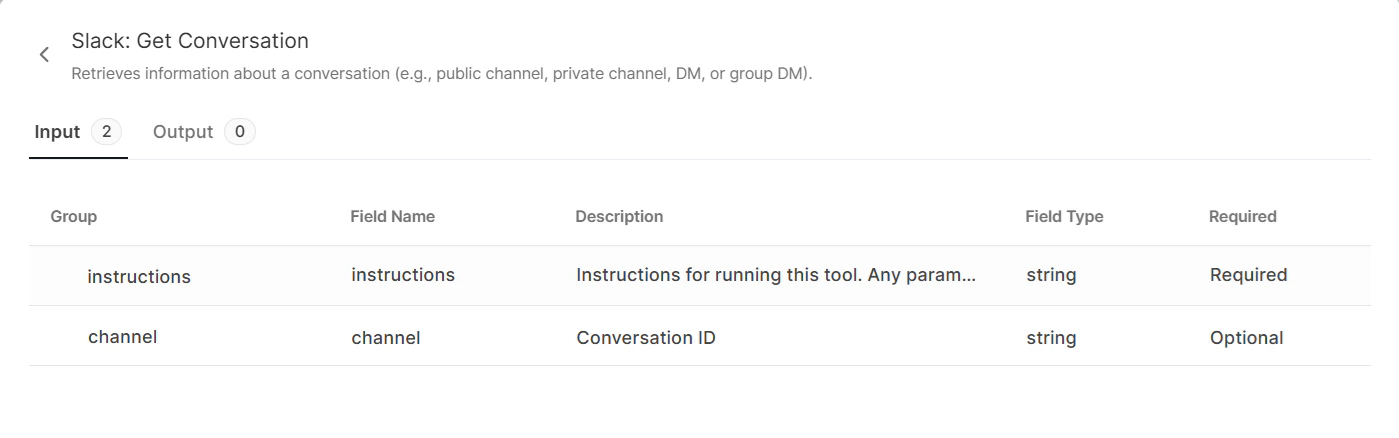
For each parameter, review:
Field Description Group Logical grouping or category of the parameter Field Name Unique identifier for the parameter Description Purpose and expected input Field Type Expected data type (string, number, boolean, etc.) Required/Optional Whether the parameter is mandatory 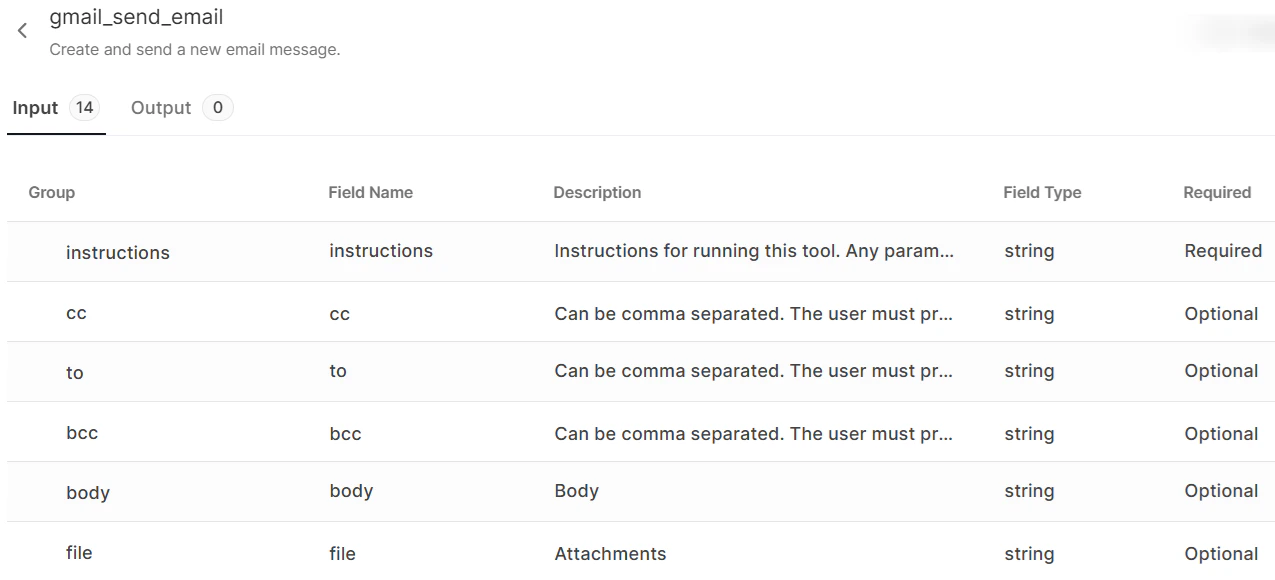
-
Choose the input type:
- Static Values: Enter the value; select form visibility; choose editable or read-only.
- Dynamic Values: Select Extract from Query to use entity extraction.
- Save the tool configuration.
You can configure multiple tools from the same MCP connection or from different connections within a single agent.
Enabling and Disabling Tools
Toggle the Enable switch on a tool to activate or deactivate it without removing the configuration. This allows temporary deactivation while preserving settings.- Enabled: The agent can invoke the tool during interactions.
- Disabled: The agent cannot use the tool, but the configuration is retained.
End-User Experience
When a user triggers an MCP Agent:- The platform displays a form with the required input fields for the selected tool.
- Data types in the form match those defined by the MCP server.
- Values extracted from the user’s query via entity extraction are pre-filled.
- The Continue button remains disabled until all mandatory fields are complete.
- When the user clicks Continue, the agent executes the corresponding MCP action.
- Results are displayed as a natural language response.
- User asks: “Send an email to
john@example.comabout tomorrow’s meeting.” - Agent displays a form:
- Recipient: Pre-filled with
john@example.com(extracted from query) - Subject: Empty field (mandatory)
- Body: Empty field (mandatory)
- Recipient: Pre-filled with
- User fills in subject and body, clicks Continue.
- Agent invokes the Gmail tool through the MCP server with all parameters.
- Result displayed: “I’ve sent the email to
john@example.comsuccessfully.”
Manage MCP Agents
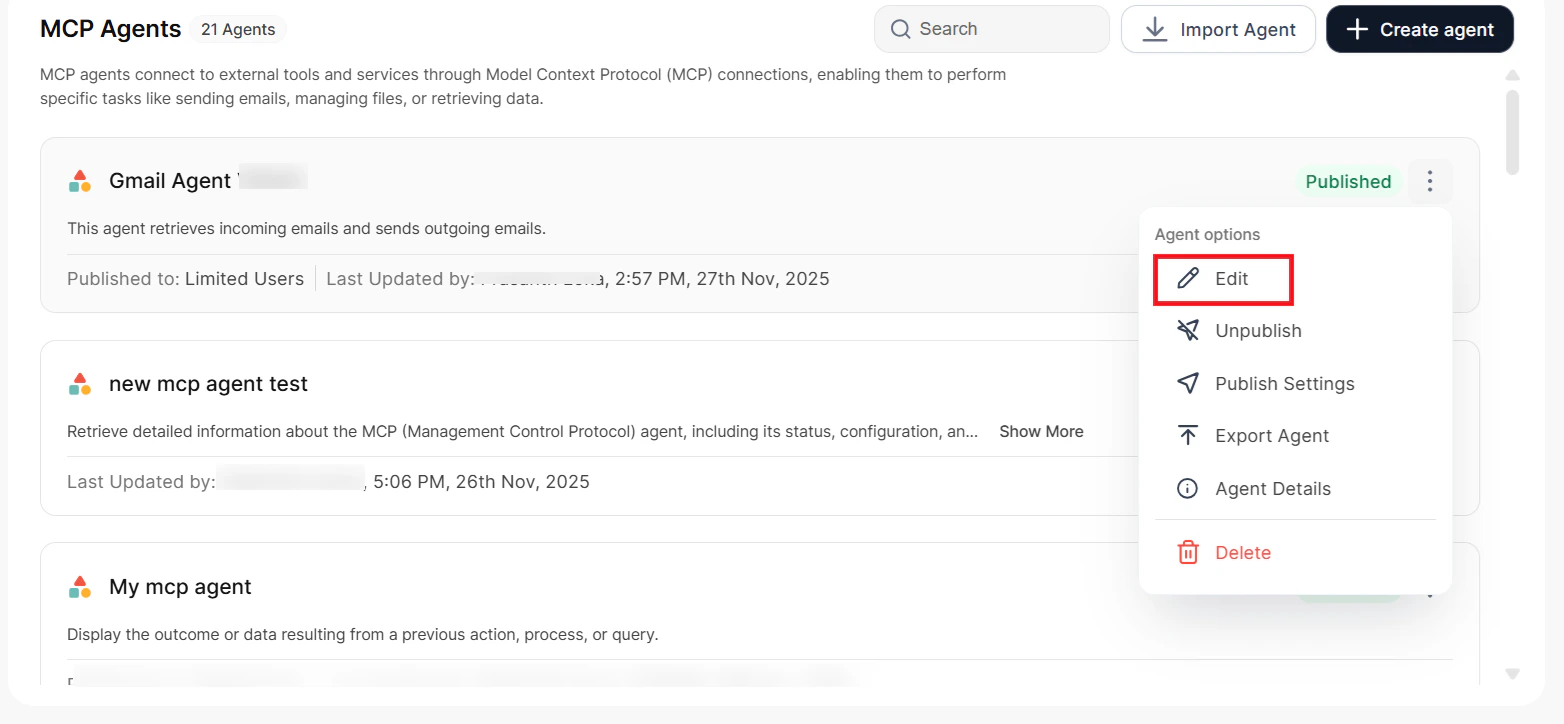
Editing an MCP Agent:- Navigate to MCP Agents and select the agent.
-
Click Edit.
- Update any of the following: agent name, description, tool selections, tool parameter configurations, or tool enable/disable status.
- Click Save. Changes take effect immediately on the next user interaction.
- During agent creation or editing, click Add MCP Tools.
- Select tools from your first MCP connection.
- Click Add MCP Tools again and select tools from a different connection.
- Configure each tool’s parameters independently.
- Save the agent.
- Refresh the MCP connection.
- Navigate to the affected agent and click Edit.
- Review tool configurations for changes.
- Reselect or reconfigure tools as needed.
- Save the agent.
The platform does not automatically update agents when MCP server definitions change. Manually review and update agent configurations to ensure compatibility with the latest tool schemas.
MCP Connections
The Model Context Protocol (MCP) is an open standard that enables AI Agents to interact with external tools, data, and services through a standardized interface.- Without MCP: Each tool integration requires separate, custom logic per system.
- With MCP: All systems are accessed through a single, consistent interface — dramatically simplifying development and reducing complexity.
Key Features
| Feature | Description |
|---|---|
| Open Standard | Universal standardized protocol for AI and tool integration |
| Simplified Development | All MCP tools accessed through the same client interface |
| Scalable Architecture | Add new tools to agents without custom integration |
| Universal Compatibility | All MCP clients communicate using a standardized protocol, ensuring seamless interoperability |
Connection Levels
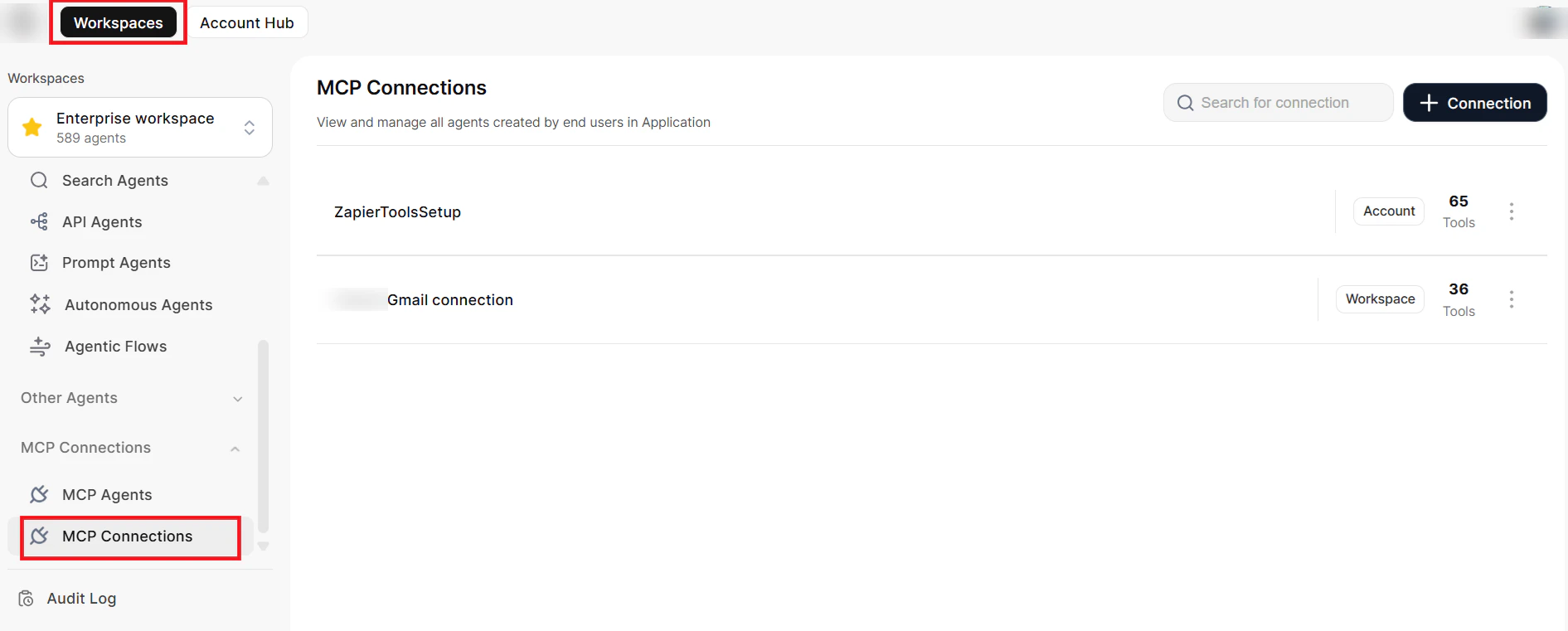
Workspace-Level Connections
- Accessible only within a specific workspace.
- Available to all agents within that workspace.
- Not visible or accessible outside the workspace.
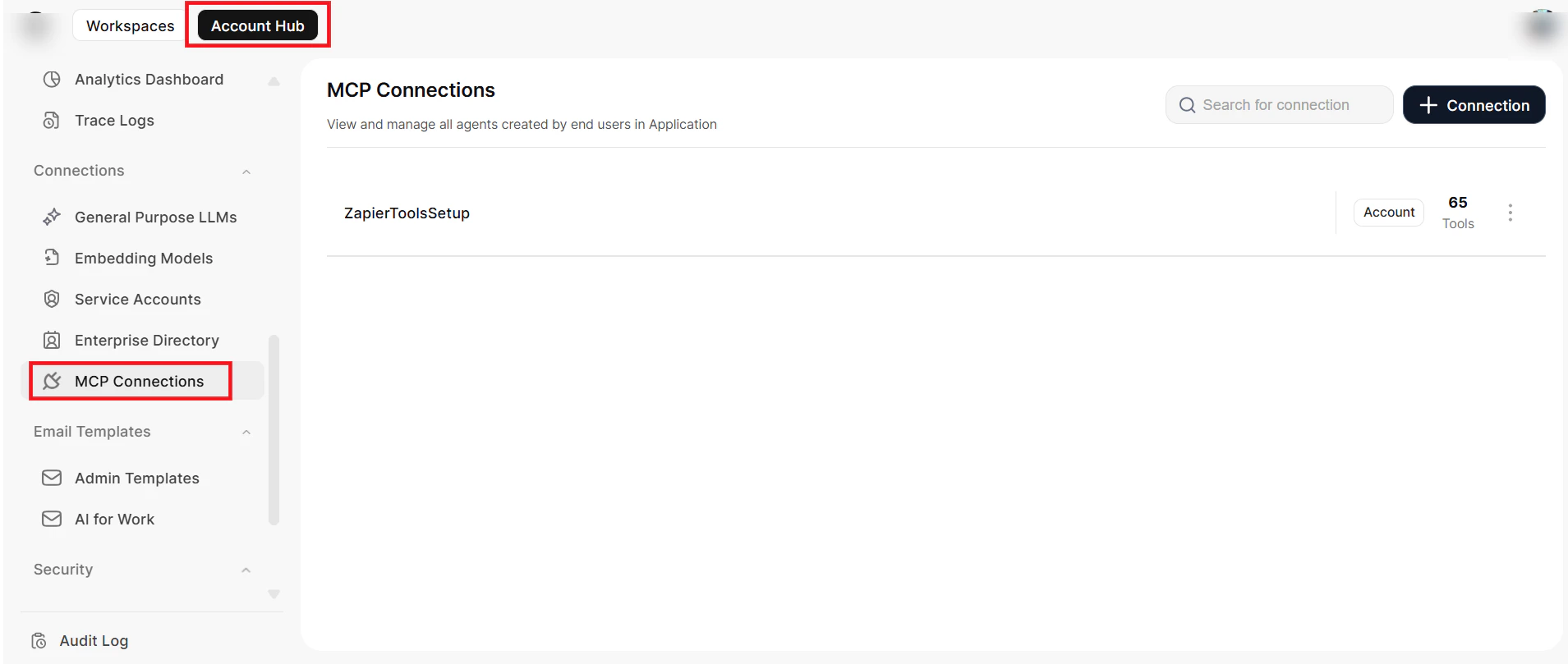
Account-Level Connections
- Created under Connections in the Account Hub.
- Accessible across all workspaces, including personal workspaces.
- When viewed from within a workspace: displayed in read-only mode; authentication profiles and URLs are hidden for security.
Create an MCP Connection
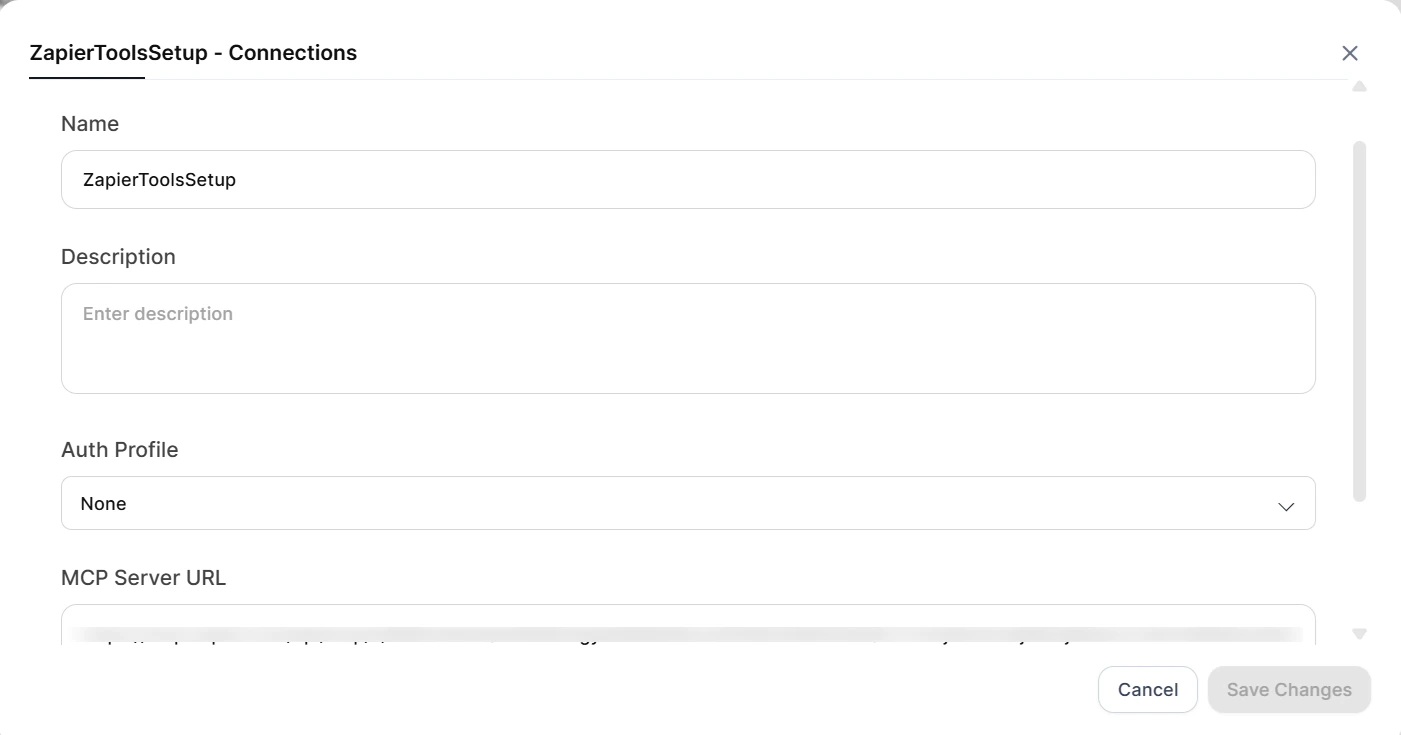
Navigate to Connections in your workspace or account view, then click Create MCP Connection.| Field | Description |
|---|---|
| Name | Descriptive name for the connection |
| Description | Details about the connection’s purpose and available tools |
| MCP URL | Endpoint URL of the MCP server |
| Authentication Profile | Authentication method required by the MCP server |
| Custom Headers (optional) | Additional headers required for server communication |
Manage MCP Connections
Refreshing a Connection: MCP servers may update tools or schemas over time. To retrieve updates:- Navigate to Connections and locate the connection.
- Click Refresh.
Dynamic MCP server updates are not reflected automatically. Manually reconfigure the MCP connection and reselect tools in affected agents to apply updates.
| Field | Description |
|---|---|
| Tool Name | Identifier for the tool |
| Description | What the tool does |
| Input | Required parameters, data types, and mandatory fields |
| Output | Structure of data the tool returns |
- Navigate to Connections, select the connection, and click Edit.
- Update server endpoints, authentication credentials, or custom headers.
- Click Save. The system validates the updated configuration and retrieves the current tool list.
Account-level connections cannot be edited from the workspace view. Access them from the account-level Connections section.
- Navigate to Connections, locate the connection, and click Delete.
- Confirm the deletion.
Deleting a connection disables all tools from that MCP server in all affected agents.
Enterprise Knowledge
Connect your agents to enterprise knowledge sources for RAG-based retrieval.Search AI Connector
Connect to Search AI for RAG-based retrieval:- Navigate to Enterprise Knowledge > Search AI.
- Select your Search AI application.
- Configure retrieval settings:
- Top K results — Number of chunks to retrieve
- Similarity threshold — Minimum relevance score
- Source filtering — Limit to specific content sources
Agentic Apps Connector
Use Agent Platform apps as knowledge sources:- Navigate to Enterprise Knowledge > Agentic Apps.
- Select the agentic app to connect.
- Configure access permissions.
Amazon Q Connector
Connect Amazon Q for AWS-based knowledge:- Navigate to Enterprise Knowledge > Amazon Q.
- Configure AWS credentials.
- Select the Amazon Q application.
- Set access permissions.
Publishing Your Agent
All agent types share the same publishing options, configured in the final step of the creation wizard. Publish To — Define access permissions:- Everyone in the Account: Make the agent available to all users.
- Limited Users: Grant access to specific workspace users or groups defined in workspace publish settings.
- Always Enabled: The agent remains active and cannot be disabled by users.
- Users Choice: Users can enable or disable the agent as needed.
Publishing options are defined in Workspace settings. See Workspace for additional information.
Agent Management
Versioning
Track changes to agent configurations:- View version history
- Compare versions
- Roll back to previous versions
- Tag versions for releases
Access Control
Configure who can access and modify agents:| Role | Permissions |
|---|---|
| Owner | Full control, delete |
| Editor | Modify configuration |
| Viewer | View only |
| User | Interact with deployed agent |
Monitoring
Track agent performance:- Conversation volume
- Response quality metrics
- Error rates
- User satisfaction
Best Practices
Instructions
- Be specific about agent scope and limitations.
- Include examples of good responses.
- Define escalation paths for edge cases.
- Specify tone and communication style.
Knowledge
- Keep knowledge sources up to date.
- Use specific source filtering for accuracy.
- Test retrieval quality regularly.
- Monitor for outdated information.
Testing
- Test edge cases and error scenarios.
- Validate tool integrations.
- Check guardrail effectiveness.
- Get feedback from target users.